Home › Holiday lets › Wales register and levy
Do I need to register my holiday let in Wales?
Almost certainly, yes. From 2027 everyone in Wales who takes paid bookings for short stays — holiday cottages, Airbnb rooms, B&Bs, hotels, campsites and glamping — must be on a new register run by the Welsh Revenue Authority. Where councils choose to charge it, a visitor levy goes on top. Here’s what to do and when.
The short version
- If you take bookings for stays of 31 nights or less in Wales, register with the WRA by 31 March 2027 — or before you first offer stays, if that’s later. It’s free.
- You must register even if your council doesn’t charge the levy. Not registering can cost £100 per premises, rising to £1,400.
- Report changes to your registration within 30 days.
- Where a council charges the levy it’s £1.30 per person per night, or 75p for tent pitches and hostel dorm or shared-room beds.
- Cardiff charges it on stays from 1 April 2027, including bookings made from 28 September 2026 — so bookings you’re taking now may already be caught.
- Returns are quarterly (due 60 days after each quarter), or annual if your levy is £1,000 or less. Nil returns are required.
Who must register
Anyone who takes bookings for overnight stays of 31 nights or less in Wales, in return for payment. That includes:
- holiday cottages, flats and other self-catering lets, including Airbnb and similar platforms;
- spare rooms and homestays;
- B&Bs, guesthouses, hotels and hostels;
- campsites, caravan pitches, static caravans and glamping.
The register covers every council area in Wales, whether or not the council charges the visitor levy. A Pembrokeshire campsite with no levy still needs to register.
How to register and keep it up to date
- Register online with the Welsh Revenue Authority by 31 March 2027. If you start offering stays after that date, register before you first offer them.
- List each premises you let: its address, type of accommodation and contact details.
- When something changes — new premises, a change of contact details, you stop letting — update the register within 30 days.
- The penalty for not registering is £100 per premises, rising to up to £1,400.
The visitor levy rates
| Accommodation | Rate per person per night | Under-18s |
|---|---|---|
| Holiday lets, rooms, B&Bs, hotels, glamping, caravans | £1.30 | Counted every night |
| Tent pitches, hostel dorm or shared-room beds | 75p | Not counted on the first night |
A family of two adults and two children staying four nights in a Cardiff holiday flat: 4 people × 4 nights × £1.30 = £20.80.
Which councils charge it
Each of the 22 councils decides whether to charge the levy, and can only start on 1 April or 1 October. When we checked, Cardiff had confirmed it will charge it on stays from 1 April 2027. Other councils may follow — check your council’s announcements and gov.wales.
Advance bookings and the 31-night rule
- Cardiff’s levy applies to bookings made from 28 September 2026 for stays from 1 April 2027. Bookings made before that date are outside it.
- For a stay that starts before the levy and ends after it, only the nights from the start date count.
- Stays where everyone is entitled to stay more than 31 nights aren’t overnight stays for the levy.
- The levy becomes due when the stay ends, so each booking belongs to the quarter of its check-out date. Cancelled bookings have no levy.
Returns and paying the levy
- Quarterly returns are due 60 days after each quarter: around 29 August, 29 November, 29 February (or 1 March) and 30 May.
- You can file once a year instead, by 31 May, if your expected levy is £1,000 or less and last year’s was too.
- You must file a nil return for a period even if no levy is due.
- You file and pay through the Welsh Revenue Authority. Keep booking records to show how you worked it out.
Charging guests, platforms and VAT
- You can pass the levy on to guests, but the total price you show must include it.
- Booking platforms may collect the levy for you, but you’re still responsible for registering and for your returns.
- If you’re VAT-registered, VAT is due on the levy you charge.
Your checklist
- List every premises you let in Wales, with its council and type.
- Register them all with the WRA before 31 March 2027, and note your registration number.
- If any are in Cardiff, check bookings made from 28 September 2026 for stays from 1 April 2027 and make sure your prices include the levy.
- Decide whether you’ll file quarterly or annually.
- Log each booking: dates, adults and under-18s, and the levy charged.
- Diary your return dates, and keep a log of changes to report within 30 days.
Free tool: Work out the Cardiff levy on a booking with our free visitor levy calculator.
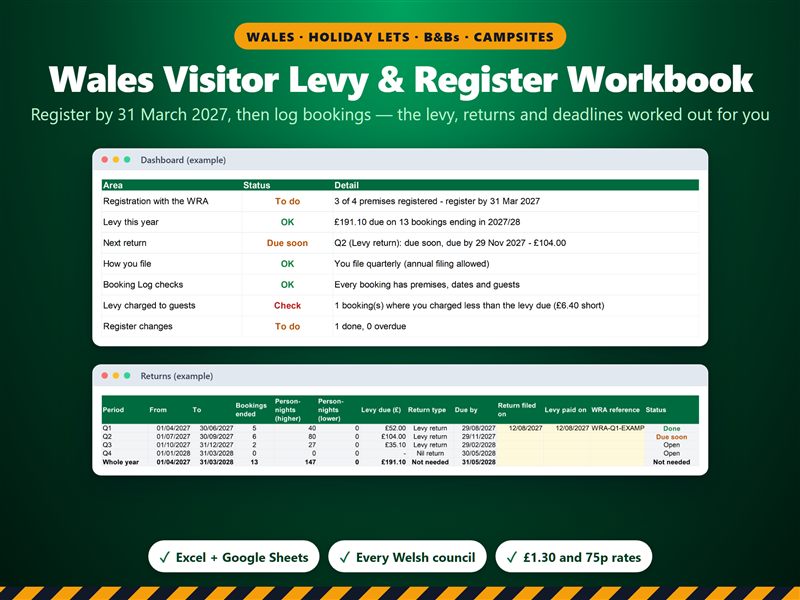
Your premises and register status, a booking log that applies the council’s start date, booking cut-off, the 31-night rule and both rates, quarterly or annual returns with due dates, and a 30-day changes log. All 22 Welsh councils. Excel and Google Sheets.
Wales workbook on EtsyAlso letting in Scotland? See Scotland’s visitor levy: a guide for hosts.