Home › Holiday lets › Scotland visitor levy
Scotland’s visitor levy: a guide for hosts
Scottish councils can now charge a visitor levy on overnight stays. Edinburgh started in July 2026, Glasgow follows in January 2027 and three more councils have agreed schemes for 2027. If you let a holiday home, a room or run a B&B, here’s how it works — including bookings you’re taking today.
The short version
- Each council runs its own scheme: its own rate, start date, cut-off for advance bookings, night cap and exemptions.
- It’s a percentage of the accommodation price — not meals, parking or extras — worked out on the price without VAT.
- Advance bookings count: a booking made after the council’s cut-off date for a stay after the start date must include the levy.
- Returns and payments are made quarterly through visitorlevy.scot. Some councils let providers keep a small share to cover costs.
- Keep booking records for 5 years after each stay.
Which councils, and when
| Council | Rate | Stays from | Bookings made from |
|---|---|---|---|
| City of Edinburgh | 5%, first 5 consecutive nights | 24 July 2026 | 1 October 2025 |
| Glasgow City | 5%, whole stay | 25 January 2027 | April 2026 |
| Aberdeen City | 7%, whole stay | 1 April 2027 | 1 October 2026 |
| Stirling | 3% (refund for nights after the first 7) | 14 June 2027 | 1 January 2027 |
| West Dunbartonshire | 5%, whole stay | 1 July 2027 | 1 October 2026 |
Dundee, Falkirk, Highland and Perth and Kinross have been consulting on schemes. Since a 2026 change in the law, councils can also choose a fixed amount per room per night instead of a percentage. Always check your council’s own scheme page.
How the levy is worked out
- Take the price of the accommodation only. Leave out meals, parking, transport and other extras.
- If you’re VAT-registered, use the price without VAT.
- Apply the council’s rate to the nights that count. In Edinburgh that’s only the first 5 nights, counted from the first night of the stay.
Example: a 7-night Edinburgh stay costing £1,190 (no VAT) is £170 a night. The levy is 5% of 5 nights: 5 × £170 × 5% = £42.50.
Some guests are exempt (for example under some councils’ schemes, people receiving certain disability benefits). They usually pay the levy and claim a refund from the council.
Advance bookings
This is the part that catches hosts out. Each council sets a cut-off date some months before the levy starts. A booking made on or after that date, for a stay that ends after the start date, must include the levy — even though the booking was taken before the levy began.
For Glasgow, bookings made from April 2026 for stays from 25 January 2027 are caught, so many 2027 bookings already on your calendar will need it. For a stay that straddles the start date, only the nights from the start date count.
Returns, payments and the share you keep
- Returns and payments go through the national service at visitorlevy.scot, usually quarterly. Edinburgh’s first return covered 24 July to 30 September 2026 and was due in October 2026.
- Some councils let providers keep a share of the levy to cover costs — Edinburgh 2%, Glasgow and West Dunbartonshire 1.5%.
- If you let in more than one council area, you file to each council.
The records to keep
For every booking: the dates, the accommodation price (and how you separated out extras), the levy you charged, and cancellations. Keep them for 5 years after each stay. Councils can check your returns.
Your checklist
- Check which council each of your properties is in, and read its scheme.
- Sign up on visitorlevy.scot before your council’s levy starts.
- Go through your forward bookings: anything made after the cut-off for a stay after the start date needs the levy.
- Update your prices and booking terms, and check whether your platform collects the levy for you.
- Log each booking’s accommodation price and levy, and diary your quarterly returns.
Free tool: Work out the levy on a booking with our free visitor levy calculator: it applies each council’s rate, night cap and booking cut-off.
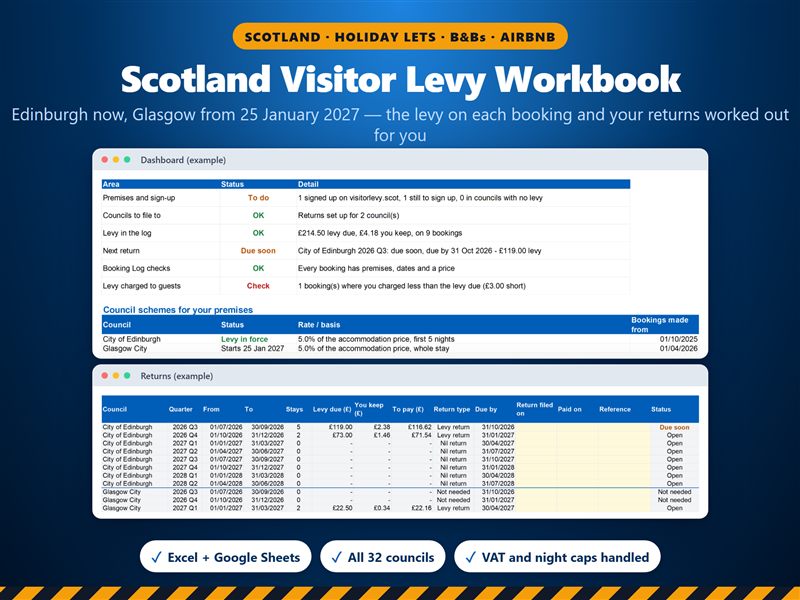
A booking log that applies each council’s rate, night cap, start date and booking cut-off, takes off VAT if you’re registered, and shows the share you keep and the amount to pay — with quarterly returns for up to 3 councils. All 32 councils. Excel and Google Sheets.
Scotland workbook on EtsyAlso letting in Wales? Every Welsh holiday let must register by 31 March 2027 — see do I need to register my holiday let in Wales?