Home › Martyn’s Law
Martyn’s Law: does it apply to your premises?
Martyn’s Law is the Terrorism (Protection of Premises) Act 2025. It will require many public venues — from pubs and restaurants to village halls, churches and gyms — to be ready to keep people safe if there is an attack. Here is who it covers, what the smaller “standard tier” premises must do, and how to get ready before it starts.
 VENUES & PUBLIC PREMISES
The short version
- It is expected to come into force in spring 2027. The SIA will confirm the exact date. Until then there is no legal duty to comply — but it’s worth preparing now.
- Premises where it’s reasonable to expect 200 to 799 people at the same time (including staff) are in the standard tier. 800 or more is the enhanced tier.
- Standard tier: notify the SIA and have appropriate public protection procedures so far as reasonably practicable. No physical security measures are required.
- Penalties for standard tier premises go up to £10,000, plus up to £500 a day.
Is your building in scope?
According to the SIA, your premises are likely to be in scope if all of these apply:
- they include a building or part of a building;
- they are wholly or mainly used for one of the purposes in Schedule 1 of the Act — such as shops, food and drink, entertainment and leisure, halls, places of worship, hotels, visitor attractions, health care, childcare and education, libraries and museums, and public authorities;
- it is reasonable to expect that 200 or more people will be present at the same time, from time to time, including staff;
- they are not excluded under Schedule 2 (for example open-air parks with no entry checks, or transport premises already covered by other security laws).
| People at the same time | Result |
|---|---|
| Under 200 | Not in scope |
| 200 to 799 | Standard tier |
| 800 or more | Enhanced tier (extra duties) |
| Childcare, schools, further education and places of worship with 200 or more | Standard tier, even at 800 or more |
Large events with entry checks and 800 or more people have the same duties as enhanced tier premises. This guide focuses on the standard tier.
Counting the number of people
The figure is the greatest number of people you can reasonably expect to be present at the same time, “from time to time” — which the guidance says means occasionally, not every day. It must include staff and volunteers. The Home Office’s supplementary document A sets out six methods you can use:
- Safe occupancy for fire safety (from your fire risk assessment).
- Historic attendance data, such as peak door counts.
- Fixed seating or standing positions, plus staff.
- Tickets or pre-registration: the most you can issue, plus staff.
- Restrictions, such as a capacity limit on an alcohol or entertainment licence.
- Other means, with a written justification of how and why the figure is reasonable.
Only the part of the premises used for the Schedule 1 purpose counts. Write down which method you used and why — the SIA will ask how you calculated it.
What the standard tier must do
The person responsible — the individual, organisation or company in control of the premises for the purpose that brings it into scope — must:
- Notify the SIA who the responsible person is (through the SIA’s online portal, once the law is in force).
- Have in place, so far as is reasonably practicable, appropriate public protection procedures to reduce the risk of physical harm if an attack happened at the premises or nearby.
“Reasonably practicable” means weighing what could be done against the cost, time and difficulty, taking account of the nature of the premises and the resources available. A volunteer-run village hall isn’t expected to do what a large venue would. Where you decide something isn’t reasonably practicable, the guidance suggests recording why, in case the SIA inspects.
The guidance is clear that the standard tier doesn’t require physical alterations or buying equipment. You can’t pass the responsibility on, but you can get advice from a suitably knowledgeable security adviser.
The four procedures
Evacuation
Getting people out and away from danger. The guidance warns that a fire assembly point could become a target, so plan to disperse people away instead — and remember a fire alarm may not mean a fire.
Invacuation
Moving people to a safer place inside, away from windows, glass, external walls and entrances, without overcrowding it. Often used when the danger is outside.
Lockdown
Securing doors, windows and shutters so no one can get in or out. Decide when full or partial lockdown is right, who locks what, and how fire exits still open.
Communication
Alerting staff and the public and telling them what to do — a PA, radios or a spoken instruction in a small building — and who calls 999.
There’s no legal requirement for standard tier premises to write their procedures down, but the statutory guidance says the responsible person should prepare a document so staff understand them, and that it’s good practice to document even the simplest procedures (paragraphs 7.8 and 7.32). Make sure the terrorism procedures fit with your fire evacuation plan rather than contradicting it.
Staff, volunteers and practice
- There’s no requirement for specific counter-terrorism training, but staff with a part to play must be made aware of the procedures and their role (paragraph 7.51).
- Awareness can be a briefing, induction, shadowing or e-learning. The free ACT Awareness course on ProtectUK takes about 45 minutes and covers spotting suspicious items and behaviour.
- Plan how you’ll test and practise the procedures, and review them — the guidance suggests at least once a year.
- If you share a building or exits with others (a shopping centre, a church hall next to a school), co-ordinate so your plans don’t clash.
One example in the guidance is a village hall that briefed its volunteers when they joined, wrote its lockdown procedure down and pinned it up in the staff room — and decided paid training wasn’t needed.
Notifying the SIA
- If you’re responsible when the law starts, notify the SIA within 3 months of the start date.
- If you become (or stop being) responsible later, notify within 28 days (or by the end of the first 3 months, if later).
- If anything you told the SIA becomes inaccurate, update it within 28 days.
The SIA will ask for, among other things: the responsible person’s details (and company or charity number), anyone else with control of the premises, the address, the Schedule 1 use, the greatest number of people expected at one time and how you worked it out, websites and social media used to advertise the premises, and any alcohol, entertainment or sports ground licences. Knowingly or recklessly giving false or misleading information is an offence. The SIA is building an online portal and plans to test it with volunteers from early 2027.
Enforcement and penalties
The SIA will assess compliance through desk-based checks and on-site inspections, usually with at least 72 hours’ notice, focusing on whether reasonable steps have been taken. It can issue compliance notices, and penalty notices of up to £10,000 for standard tier premises, plus a daily penalty of up to £500 for continued non-compliance (statutory guidance 9.14 and 9.16). Restriction notices apply only to enhanced tier premises and events.
What to do now
- Work out your figure using one of the six methods, and keep the evidence.
- Gather the information the SIA will ask for, so you can notify as soon as the portal opens.
- Draft the four procedures, check they fit your fire plan, and write them down.
- Brief everyone with a role, and plan a short talk-through.
- Sign up for SIA updates on GOV.UK so you hear the confirmed start date.
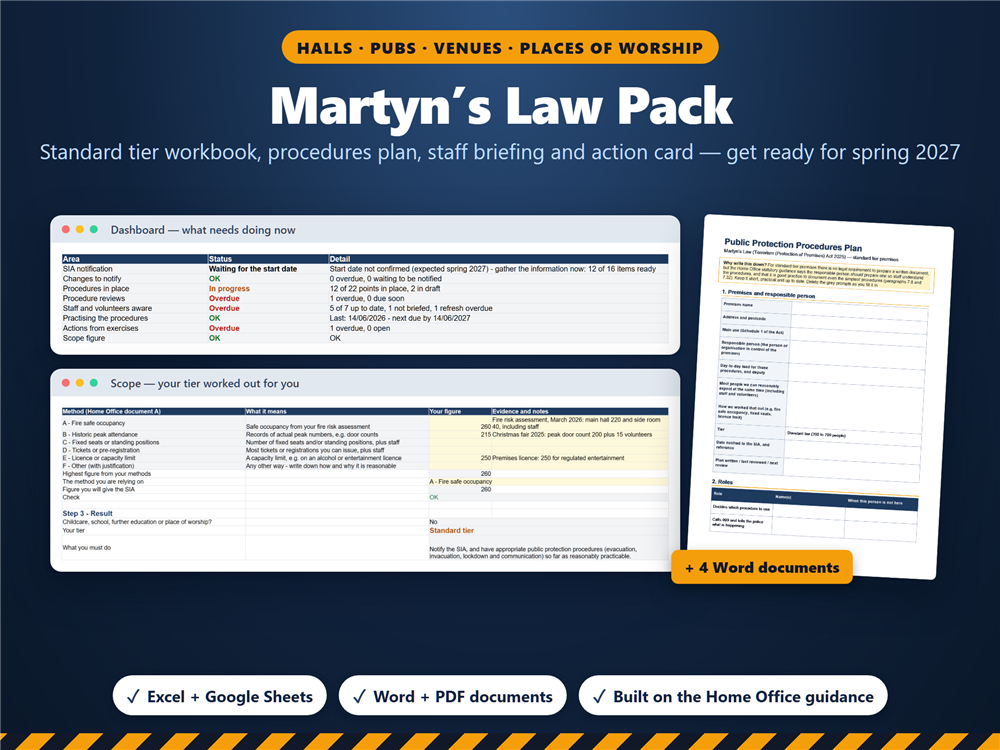
Our Martyn’s Law Pack has a 10-tab Excel and Google Sheets workbook (scope and tier, SIA notification checklist and deadlines, the 22 points to consider for the four procedures, staff awareness, exercises, decisions and contacts, with a dashboard), plus a Procedures Plan, Staff Briefing with sign-off, Action Card and SIA Notification Checklist in Word and PDF.
See the template on EtsyOfficial sources
- GOV.UK: Understanding Martyn’s Law and the SIA’s role as regulator
- GOV.UK: Terrorism (Protection of Premises) Act 2025 — statutory guidance and supplementary documents
- GOV.UK: Notification requirement
- GOV.UK: Terrorism (Protection of Premises) Act 2025 collection
- ProtectUK: free guidance and ACT Awareness e-learning