Home › Landlords
Renters’ Rights Act: a landlord’s compliance checklist
The rules for private landlords in England changed on 1 May 2026, and the national landlord register opens in December. Here is what you must do now, what’s coming next, and the safety certificates that still apply to every let.
 LANDLORDS
The short version
- All tenancies are now assured periodic tenancies with no end date, and you need a legal reason (a ground for possession) to evict.
- Existing tenancies needed the information sheet (or written terms, if verbal) by 31 May 2026.
- Rent can go up once a year at most, using Form 4A with at least 2 months’ notice.
- Register on the new landlord register within 3 months of your region being called, and by 14 November 2027 at the latest.
- Keep up the safety basics: gas safety check every 12 months, electrical inspection every 5 years, a valid EPC, alarms, and deposit protection within 30 days.
What changed on 1 May 2026
- Assured shorthold tenancies became assured periodic tenancies, running on a rolling basis (for example monthly). A tenancy agreement can’t have an end date.
- If you had a written agreement, you didn’t need a new one, but you had to give your tenants the Renters’ Rights Act Information Sheet by 31 May 2026. If the tenancy was verbal, you had to give written information about its key terms by the same date.
- Section 21 “no fault” evictions have ended. You must serve a section 8 notice using one or more grounds for possession — often with 4 months’ notice, though some grounds are shorter.
- You can’t use the selling or moving-in grounds in the first 12 months of a tenancy.
- The court only has to give possession for rent arrears if the tenant owes 3 months’ rent.
- You can’t take rent before the tenancy agreement is signed, discriminate against tenants on benefits or with children, or accept offers above your advertised rent. Tenants can ask to keep a pet, and you can only refuse for a valid reason.
Rent increases
To increase the rent, fill in Form 4A and give it to your tenant with at least 2 months’ notice (the section 13 process). You can’t increase the rent more than once a year, and rent review clauses can’t be used instead. Tenants can challenge an increase that’s above the open market rent. For now challenges go to the First-tier Tribunal; the government has announced that HMRC’s Valuation Office will take over these decisions in future.
The landlord register
The government’s Register your rental property service launches on 15 December 2026, starting in the West Midlands and reaching other areas over 12 months.
- When your area is called, you’ll have 3 months to register.
- All landlords actively letting property must be registered by 14 November 2027.
- It will be a legal requirement, with a risk of a fine if you don’t register. A landlord who isn’t registered generally can’t get a possession order.
- At first it applies to properties that are let or become occupied during the rollout. Later, you’ll need to register before marketing an empty property, and adverts will need to show the registration number.
Deposits
Put your tenant’s deposit in a government-approved scheme — the Deposit Protection Service, mydeposits or the Tenancy Deposit Scheme — within 30 days of receiving it, and give the tenant the required information within 30 days too: the scheme, its dispute service, the deposit amount, why you might keep some of it, and how to get it back. Under the new rules, a court will only give a possession order if the deposit was protected properly (or returned, or a challenge has been settled).
Safety certificates and alarms
| What | How often | Key rule |
|---|---|---|
| Gas safety check | Every 12 months | By a Gas Safe engineer. Give new tenants a copy before they move in, and existing tenants within 28 days of each check. |
| Electrical inspection (EICR) | At least every 5 years | By a qualified person. Give tenants the report, and the council if it asks. |
| Energy Performance Certificate | Valid for 10 years | You must provide one. The minimum rating to let is E. |
| Smoke alarms | Checked on day one of each tenancy | On every storey used as living accommodation. |
| Carbon monoxide alarms | Checked on day one of each tenancy | In every room with a fixed combustion appliance (not gas cookers). |
| Right to rent | Before the tenancy starts | Check each adult tenant’s right to rent; repeat checks for time-limited permission. |
Houses in multiple occupation with 5 or more people need an HMO licence, and some councils license other rented homes too — check with your council.
What’s coming next
- Private Rented Sector Landlord Ombudsman. Membership will be compulsory for private landlords, likely with a small annual fee per property. The start date and fees hadn’t been set when we checked.
- Decent Homes Standard. It will become a legal duty for private rented homes. No start date yet.
- Awaab’s Law. Deadlines to investigate and fix hazards such as damp and mould will be extended to private renting. The government opened a consultation on how this will work on 9 October 2026.
Until timescales are set, it’s worth logging every repair request and how quickly you dealt with it — the evidence will matter if a complaint reaches the ombudsman or the council.
If a landlord breaks the rules
Councils have new powers to investigate. Tenants (and councils, for Universal Credit paid as rent) can apply for a rent repayment order for a wider range of offences, and the maximum has doubled from 1 to 2 years’ rent.
Your checklist
- Confirm every existing tenant received the information sheet or written terms.
- Diary the earliest date for each tenant’s next rent increase, and serve Form 4A at least 2 months before.
- Check every deposit was protected, with the required information given, within 30 days.
- Diary gas safety, EICR and EPC renewal dates for each property.
- Get ready for the landlord register: gather property and certificate details now, and watch for your region being called.
- Start a repairs and complaints log.
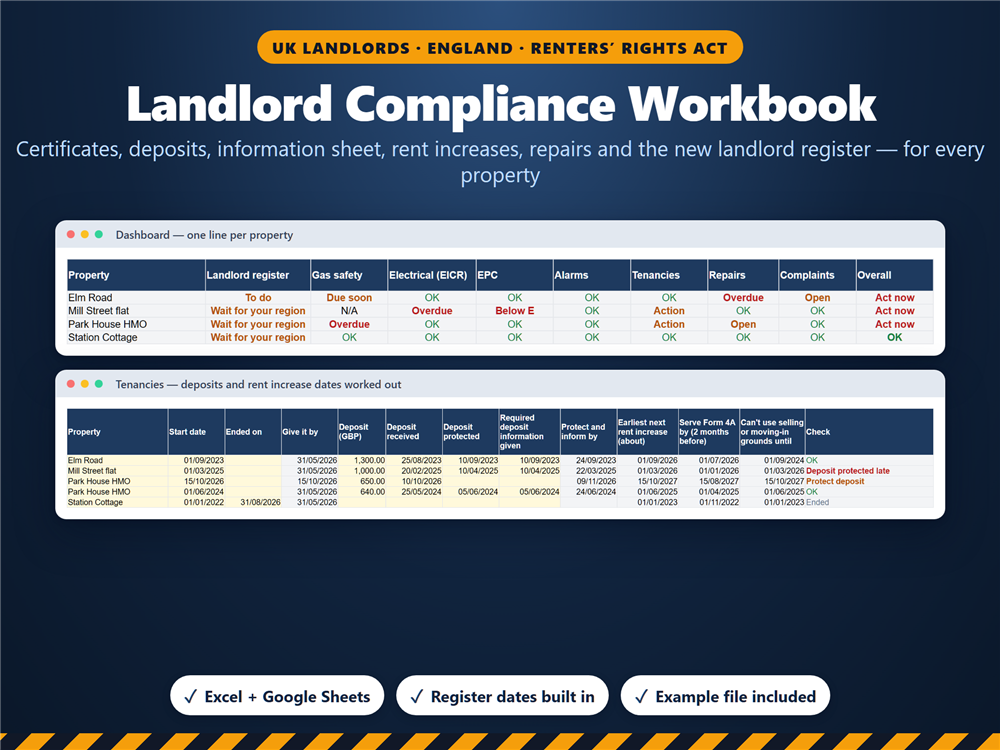
Our Landlord Compliance Workbook keeps all of this in one Excel and Google Sheets file: a dashboard per property, your landlord register deadline, gas, EICR, EPC and alarm dates, deposits, the information sheet, right to rent, rent increase dates, repairs and complaints.
See the template on EtsyRental income over £30,000? Making Tax Digital starts for you in April 2027 — check your start date.
Official sources
- GOV.UK: Renters’ Rights Act — an overview for landlords
- GOV.UK: Stronger protections and greater confidence for renters (landlord register dates)
- GOV.UK: Guide to the Renters’ Rights Act
- GOV.UK: Deposit protection schemes and landlords
- GOV.UK: Renting out your property
- HSE: Gas safety for landlords
- GOV.UK: Extending Awaab’s Law to private rented tenancies (consultation)