Home › Martyn’s Law › Places of worship › Security funding
Security funding for places of worship: which schemes are open
The Home Office pays for security measures at places of worship through three schemes, one for each of the main community groups. Here is who can apply, what they cover, and which ones are taking applications.
The short version
- Mosques and Muslim community centres: the Protective Security for Mosques Scheme (up to £40 million), applications on a rolling basis.
- Synagogues, Jewish schools and community centres: the Jewish Community Protective Security Grant (up to £28.4 million), managed by the Community Security Trust (CST).
- Churches, gurdwaras, temples and other faiths: the Places of Worship Protective Security Scheme (£5 million). Its portal was closed when we checked; the Home Office said the next window would open later in 2026.
- Martyn’s Law doesn’t require any of these measures – but they can make your procedures easier to carry out.
The three schemes at a glance
| Scheme | Who it’s for | 2026/27 funding | Status when checked |
|---|---|---|---|
| Protective Security for Mosques Scheme | Mosques in operation and associated Muslim community centres where regular worship takes place | Up to £40 million | Rolling applications |
| Jewish Community Protective Security Grant | Synagogues, Jewish schools and community centres | Up to £28.4 million | Managed by CST – contact CST |
| Places of Worship Protective Security Scheme | Churches, gurdwaras, temples, other faiths, and linked community centres with regular worship, in England and Wales | £5 million | Portal closed; next window expected later in 2026 |
What they pay for
- Physical measures such as CCTV, intruder alarms, secure fencing and gates, stronger doors and locks, window protection, entry systems and external lighting.
- Security guarding is available through the mosques scheme, and the Jewish community grant can cover on-site security staff.
- Measures are chosen after a site survey and approved by the Home Office, then installed by its approved supplier. You won’t be reimbursed if you install something yourself.
- Some measures come with a year of maintenance.
Who can apply
- You must be a place of worship, or a linked community centre where regular worship takes place. The Places of Worship scheme excludes homes, schools, cafés, youth centres and buildings not used for regular worship; the mosques and Jewish community schemes also cover some schools and community centres.
- You must be a registered charity, or exempt from registering.
- You don’t need to have suffered a hate crime to apply to the mosques scheme, though evidence of one helps. The general scheme asks you to apply if you have experienced hate crime or believe you are at risk.
- One application per place of worship. Mosques can reapply 12 months after their last measure was installed.
How this fits with Martyn’s Law
Places of worship with 200 or more people present at the same time are in the standard tier, however large. The standard tier needs two things: notify the SIA, and have evacuation, invacuation, lockdown and communication procedures. There is no requirement to install CCTV, alarms or stronger doors.
Funded measures can still help. Doors that close and lock quickly make lockdown easier; a PA or entry system helps with communication; good lighting helps people leave safely. If you are applying for funding, think about how each measure supports the procedures you already have.
Free training
- Faith Security Training from the Home Office is free for faith communities in England and Wales.
- ACT Awareness e-learning on ProtectUK is free and takes about 45 minutes.
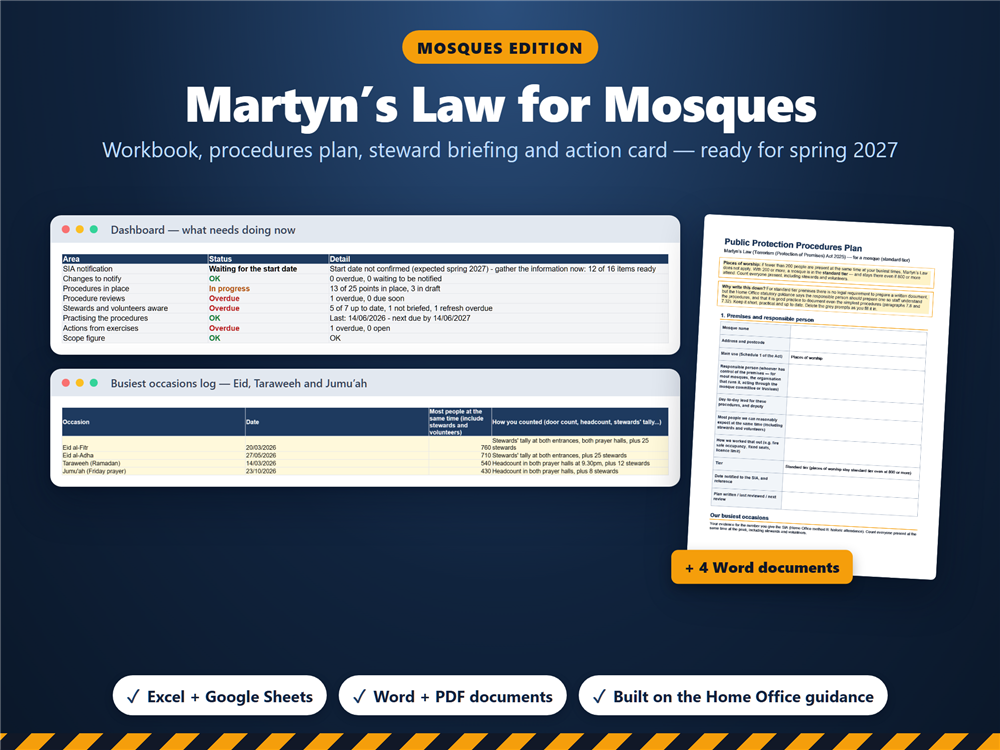
Our Martyn’s Law workbooks for churches and mosques work out your tier from your busiest occasions, guide you through the points the guidance asks you to consider, and come with a Procedures Plan, Steward Briefing, Action Card and SIA Notification Checklist.
Church template Mosque templateRelated: Martyn’s Law for places of worship · What your stewards need to know · Churches · Mosques