Home › Martyn’s Law › Places of worship › Stewards
Martyn’s Law: what your stewards and volunteers need to know
At most churches, mosques, gurdwaras and temples, the people who would actually carry out your Martyn’s Law procedures are volunteers on the door. Here is what they need to know, what they don’t need to do, and a simple way to brief them.
The short version
- The Act asks for procedures that the people working on the premises follow if an attack is happening or about to happen. It does not require formal counter-terrorism training.
- Your stewards need to know four things: how to get people out, where to move them inside, how to secure the doors, and how to tell everyone what to do.
- They are not expected to search bags, confront anyone or act as security guards.
- A short briefing, a one-page action card and a list of who has been briefed is a practical way to show your procedures work.
What the law actually asks
Every place of worship in scope – where 200 or more people can be present at the same time – is in the standard tier, however large. The responsible person has two duties: tell the Security Industry Authority (SIA) who they are, and have appropriate “public protection procedures” in place, so far as reasonably practicable.
Section 5 of the Act says those procedures are for the individuals working on the premises to follow if they suspect an act of terrorism is happening or about to happen. In most places of worship, the people on duty at a busy service are volunteers – sidespeople, welcomers, stewards and committee members – so the procedures only work if they know them.
The four things every steward should know
1. Getting people out
Which exits to use, who opens them, and that people should move away and disperse rather than gather at the usual assembly point.
2. Moving people inside
If the danger is outside: which room people go to, away from glass and the main doors, and who leads them there.
3. Securing the doors
Which doors to close and lock, who does each one, and that exits must still open from the inside so people can escape.
4. Telling everyone
How the message is given – PA, a spoken instruction from the front, a steward at each door – and who calls 999.
Beyond the four procedures, it helps if every steward knows where the first aid kit is, how to reach anyone in a side room, hall or gallery, and who is in charge on the day.
The UK’s public advice for a weapons or firearms attack is Run, Hide, Tell: get away if there is a safe route, hide if there isn’t, and call 999 when it is safe. It is a useful, memorable starting point for volunteers.
What stewards don’t have to do
- No searches. Bag checks and other physical security measures are not required for standard tier premises.
- No confrontation. Stewards are not security guards. Their job is to get people to safety and raise the alarm.
- No formal qualification. The Act does not require a licence, certificate or set training course.
- No extra paperwork for them. The responsible person keeps the records; stewards just need to know their part.
How to brief them
- Keep it short. Ten to fifteen minutes before your first big service of the season is enough.
- Walk the building. Show the exits, the room you’d use for invacuation and the doors you’d secure.
- Give each person a role. “You take the north door” is clearer than “everyone helps”.
- Hand out an action card. One page they can keep in a pocket: the four procedures, the 999 reminder and who is in charge.
- Repeat it. Once a year, after any change to the building, and when new volunteers join.
Keeping a record
The statutory guidance says the responsible person should write the procedures down, and it may be hard to show compliance if the SIA inspects and nothing is written. A simple list of who has been briefed, when and by whom is a practical way to show that the people on duty know them. Keep it with your busiest occasions log and your procedures.
Free training if you want it
- Faith Security Training from the Home Office is free for faith communities in England and Wales, with modules for different faiths.
- ACT Awareness e-learning on ProtectUK is free and takes about 45 minutes.
Neither is required by Martyn’s Law, but both are a good way for volunteers to feel confident.
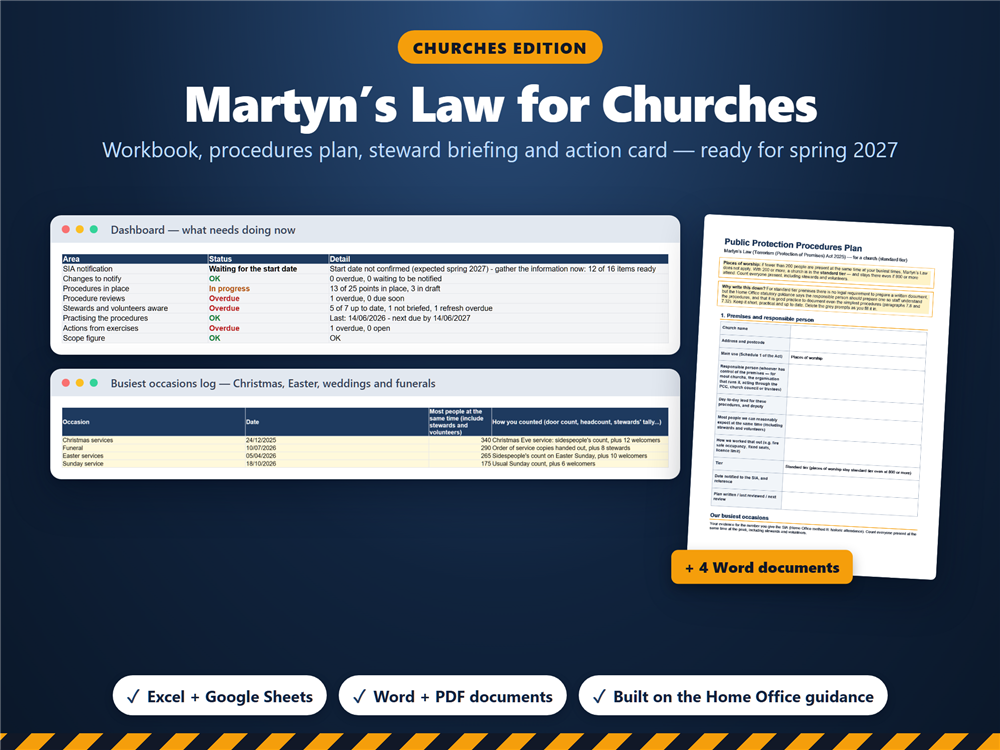
Our Martyn’s Law workbooks for churches and mosques include a Steward and Volunteer Briefing, a pocket Action Card and a record of who has been briefed, alongside a Procedures Plan and SIA Notification Checklist in Word and PDF.
Church template Mosque templateRelated: Martyn’s Law for places of worship · How to count attendance at your busiest services · Security funding for places of worship