Home › Martyn’s Law › Places of worship › Counting attendance
How to count attendance for Martyn’s Law at your busiest services
Whether Martyn’s Law applies to a church, mosque or other place of worship comes down to one number: the most people you can reasonably expect inside at the same time. Get that number right, write down how you got it, and you know where you stand. This guide explains what the Home Office means, who to count, and how to count on the day.
The short version
- The number is the most people present together — not the total through the door in a day.
- It only has to happen from time to time: a few big services a year is enough. A genuine one-off you couldn’t have expected doesn’t count.
- Count everyone: worshippers, children, visitors, faith leaders, musicians, stewards and volunteers.
- For places of worship, the most useful evidence is a log of your busiest occasions — the date, the number and how you counted.
- The SIA can ask how you worked the number out, so keep your workings.
“At the same time, from time to time”
At the same time means together, at one moment. If you hold two services or two jama’at on the same morning, each is counted on its own. The Home Office’s example is a stately home that sometimes has 850 visitors in a day, but never more than 300 there at once — it is assessed on 300. The catch is the changeover: if the second congregation arrives and waits inside before the first has left, your busiest moment may be that overlap.
From time to time means occasionally. The guidance says the threshold can be met only at certain times of the year and still count, and that it is not an average over a day or a week. So if Christmas or Eid regularly brings more than 200, you are in scope even if most weeks are much quieter. It also says one unexpected busy occasion, which you couldn’t reasonably expect again, doesn’t bring you into scope — but if it starts happening every year, it does.
Who to count, and where
- Everyone present: adults and children, regular worshippers and visitors.
- Staff, which includes volunteers. The Home Office defines staff as everyone working at the premises, including employees, contractors and volunteers. So clergy, imams, choirs and musicians, stewards, sidespeople, welcomers and helpers all count.
- Every part of the place of worship in use at the time: separate prayer halls, the women’s area, galleries, upper floors, and rooms used for children’s groups or classes during the service.
- Outdoor areas that are part of your premises, if people use them at your busiest times. The Home Office’s own example of a café counts its outdoor seating.
- Not people outside your premises — on the public pavement or in the street. The guidance says the “immediate vicinity” isn’t counted, though your procedures should still think about people gathered there.
- Not parts of the building used for something else, such as a flat or a separately let shop. Only the part used as the place of worship counts.
The six Home Office methods
Supplementary document A lists six ways to reach the figure. They are examples, not rules — you can use more than one, and the guidance asks for judgement.
| Method | What it means | For a place of worship |
|---|---|---|
| A: Safe occupancy | The most people the building can safely hold, from the fire risk assessment | Useful as a ceiling, but often higher than you ever actually get |
| B: Historic attendance | Records of actual numbers at peak times | Usually the best fit: a log of your busiest occasions |
| C: Fixed seats or standing places | The number of fixed seats, plus staff | Works for churches with fixed pews; less so for open prayer halls |
| D: Tickets or registration | The most tickets or places you can issue | Only for ticketed events, such as some concerts or carol services |
| E: Restrictions | A capacity limit, such as one on a licence | Rare for places of worship |
| F: Other means | Any other reasonable way, with a written justification | For example, counting prayer rows or mats |
The guidance warns that past numbers aren’t always a reliable predictor, so review your figure regularly — for example after your congregation grows, or a new housing estate opens nearby.
How to count on the day
Pick the moment when the building is fullest — usually just after the service or prayer begins — and use whichever of these suits your building:
- Door count. A steward on each entrance with a tally counter, counting people in and out. Accurate, but needs one person per door.
- Section headcount. Divide the building into areas (front pews, back pews, gallery; main hall, sisters’ hall, upstairs) and have one steward count each area at the same moment. Add them up.
- Rows or mats. Count the full rows or prayer lines and multiply by the number per row. Quick, and easy to repeat.
- Service sheets or orders of service handed out, as a rough guide — but remember children and people who share.
Then add the people who weren’t in the seats: the faith leader, musicians, stewards, welcomers and anyone in side rooms or classes. If you are close to 200, count carefully rather than guessing, and count again at the next big occasion.
Two worked examples
These are illustrations we have made up, not examples from the Home Office.
A parish church at Christmas. The church has pews for 220. Most Sundays bring about 80, but the Christmas Eve crib service is packed: the stewards count 290 in the pews and standing at the back, plus the vicar, 8 musicians and 12 sidespeople and welcomers — 311 in total. That happens every Christmas, so it is “from time to time”. The church is in the standard tier, and the log shows how it knows.
A mosque at Eid. The mosque holds two Eid prayers. The stewards count 470 in the main hall, 140 in the sisters’ hall and 20 stewards at the first jama’ah — 630. The second jama’ah is smaller, at 410. Stewards hold people for the second prayer at the gate until the first group has left, so the two groups are never inside together. The figure is 630, not 1,040. The mosque is in the standard tier — and would be even if Eid ever brought 800 or more, because places of worship stay in the standard tier.
What to write down
The SIA can require the responsible person to explain how the figure was worked out. A short record is enough:
- The occasion and date, for each of your busiest occasions.
- The number present at the same time, and the time you counted.
- How you counted it (door count, section headcount, rows) and who counted.
- Which areas were included, and that stewards and volunteers are in the total.
- The figure you are relying on, the method, and when you will review it.
If you are under 200, keep this record anyway — it is your evidence that you are not in scope.
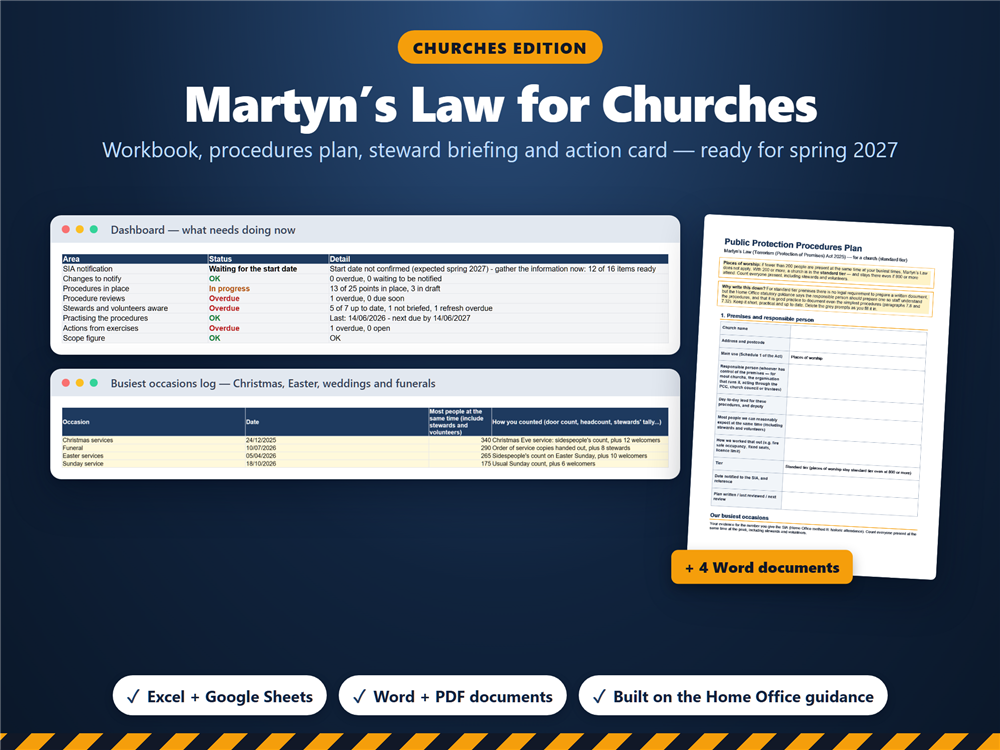
Our Martyn’s Law workbooks for churches and mosques have a busiest occasions log: enter each occasion, the number and how you counted, and the Scope tab takes the highest figure as your historic attendance evidence and works out your tier. Each comes with a Procedures Plan, Steward and Volunteer Briefing, Action Card and SIA Notification Checklist in Word and PDF.
Church template on Etsy Mosque template on EtsyRelated: Martyn’s Law for churches · Martyn’s Law for mosques · Martyn’s Law for places of worship · Martyn’s Law: does it apply to your premises?
Official sources
- GOV.UK: Supplementary document A — methods for assessing the number of individuals present
- GOV.UK: Terrorism (Protection of Premises) Act 2025 — statutory guidance and supplementary documents
- legislation.gov.uk: Terrorism (Protection of Premises) Act 2025
- GOV.UK: Understanding Martyn’s Law and the SIA’s role as regulator