Home › Martyn’s Law › Places of worship › Churches
Martyn’s Law for churches: a guide for churchwardens and PCCs
Martyn’s Law applies to churches where 200 or more people can be present at the same time. For most churches that depends on a handful of services a year — Christmas, Easter, a big wedding or funeral. Here is how to tell whether your church is in scope, who is responsible, and what the law actually asks a church to do.
The short version
- If fewer than 200 people are in the church at the same time, even at your busiest services, Martyn’s Law does not apply. Many parish churches will be in this position — keep a note of your numbers to show it.
- With 200 or more, the church is in the standard tier, and it stays there however many attend. The guidance names cathedrals as places of worship.
- Count everyone: congregation, clergy, choir, musicians, servers, sidespeople and welcomers.
- Standard tier means two things: tell the SIA who is responsible, and have four simple procedures — evacuation, invacuation, lockdown and communication. No security equipment or building work is required.
Your busiest services decide it
The test is the most people you can reasonably expect in the church at the same time, “from time to time”. The guidance says that means occasionally — the threshold can be met only at certain times of the year and still count. It is not an average, and a genuine one-off that you couldn’t have expected and don’t expect again doesn’t count.
So the services to look at are the ones that fill the church:
- Christmas: the crib service, carol services and Midnight Mass
- Easter Day and Palm Sunday
- Remembrance Sunday and civic services
- Large weddings, funerals and baptisms
- School services and concerts held in the church
The easiest evidence is a simple log: the occasion, the date, the number present at the same time and how you counted it. Many churches already keep service registers, which is a good start. If two Christmas services follow each other, count each one separately — it is the most people present together that matters, not the total for the day. Our guide to counting attendance at your busiest services goes through this step by step.
Who is the responsible person?
The Act puts the duties on the “responsible person”: the individual, organisation or company in control of the premises for their use as a place of worship. The guidance is clear that this is set by the Act, “not a matter of choice”, and that it is usually an organisation rather than one named person. Control means the right and ability to make decisions about how the building is run and who may stay on site — it doesn’t have to be the owner. The guidance says the same idea of control is used in fire safety law, so whoever is responsible for your church’s fire risk assessment is a sensible place to start.
Church structures vary. In a Church of England parish, responsibility for the building is shared between the incumbent, the churchwardens and the PCC; other denominations have trustees, elders or a church council. Agree between you which body is the responsible person, write it down, and ask your diocese or denomination if you’re unsure. The responsible person can share out the work — a lead steward or verger can run the procedures — but can’t hand over the legal responsibility.
The church hall, concerts and hiring out
- Concerts and big events in the church. The guidance gives a direct example: a concert of 800 or more people held at a church is not a “qualifying event”, and the church stays in the standard tier. Your own procedures still cover it.
- Hiring the church out. In a similar example about a synagogue hired for a fundraising concert, the place of worship’s governing body stays responsible. It can’t pass the legal duty to the hirer, but the guidance says the hire agreement can require the hirer to help — for example, providing stewards who know your procedures.
- A separate church hall. The places of worship rule only applies where the main use of the premises is worship. If your hall is used mainly for hire — parties, clubs, playgroups — it may be premises in its own right, counted on its own figures. It then follows the normal rules for halls, including the enhanced tier at 800 or more.
- Rooms in use during a service. If the hall or a side room is used at the same time, for Sunday school or a crèche, think about how those groups are told what is happening and where they go.
The four procedures in a church
Evacuation
Getting people out and away. The statutory guidance uses a church as its example: rather than gathering at the fire assembly point, which could itself be a target, people are told to disperse in several directions.
Invacuation
Moving people to a safer place inside when the danger is outside — away from windows, glass and the main doors. A vestry or side chapel may work; think about whether it can take your Christmas numbers.
Lockdown
Securing doors so no one can get in. Old, heavy doors can be slow to close and bolt, so decide in advance who secures which door, and make sure exits still open to let people escape.
Communication
How people are told what to do — the PA, a clear spoken instruction from the front, or a steward at each door — and who calls 999. Include anyone in the hall, gallery or tower.
Write the procedures down, even briefly. The guidance says the responsible person should, and that it may be hard to show compliance if the SIA inspects and nothing is written down. Check they fit your fire evacuation plan. For very large churches and cathedrals, the guidance suggests also looking at the extra considerations written for bigger premises (paragraphs 8.2 to 8.6).
The procedures should also think about the area just outside — the porch, the churchyard path and the pavement — where people gather before and after services, even though people outside the church aren’t counted towards the 200.
Sidespeople, welcomers and stewards
There is no requirement for formal counter-terrorism training. What the Act does need is that everyone with a part to play knows the procedures and their role. In a church that usually means the clergy, churchwardens, sidespeople, welcomers, vergers and anyone on the door. A short briefing before your first big service of the season, with a list of who has been briefed and when, is a practical way to show it. Run a quick talk-through once a year and after any change to the building or your plans.
Free training and funding
- Faith Security Training from the Home Office is free for faith communities in England and Wales, with a module for Christian communities. It suits sidespeople and stewards.
- ACT Awareness e-learning on ProtectUK is free and takes about 45 minutes.
- The Home Office’s Places of Worship Protective Security Scheme can provide measures such as CCTV and stronger doors for churches and other places of worship. When we checked on 25 October 2026, its application portal was closed. The GOV.UK page on protective security for faith communities shows the current position. Martyn’s Law itself doesn’t require any of these measures.
What to do now
- Count your busiest services this Christmas and Easter, and keep the figures with the date and how you counted.
- If the numbers stay under 200, keep the log — that is your evidence that you’re not in scope.
- If they reach 200, agree who the responsible person is and gather the details the SIA will ask for.
- Write short evacuation, invacuation, lockdown and communication procedures that fit your fire plan.
- Brief your sidespeople and welcomers, and note who has been briefed.
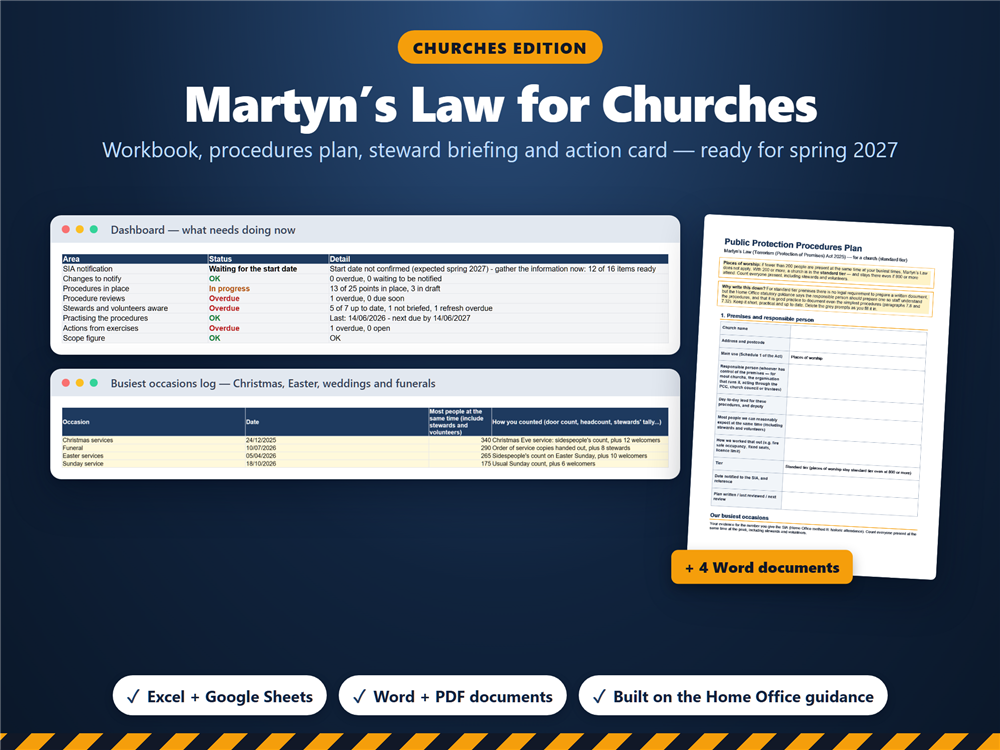
Our Martyn’s Law workbook for churches has a busiest occasions log for Christmas, Easter, weddings and funerals that works out your tier, the 22 points the guidance asks you to consider plus 3 for churches, and a record of which stewards have been briefed. It comes with a Procedures Plan, Steward and Volunteer Briefing, Action Card and SIA Notification Checklist in Word and PDF.
See the church template on EtsyRelated: Martyn’s Law for churches, mosques and other places of worship · How to count attendance at your busiest services · Martyn’s Law: does it apply to your premises?
Official sources
- GOV.UK: Terrorism (Protection of Premises) Act 2025 — statutory guidance and supplementary documents
- legislation.gov.uk: Terrorism (Protection of Premises) Act 2025
- GOV.UK: Understanding Martyn’s Law and the SIA’s role as regulator
- GOV.UK: Faith security training
- GOV.UK: Protective security for faith communities