Home › Martyn’s Law › Places of worship
Martyn’s Law for churches, mosques and other places of worship
Martyn’s Law (the Terrorism (Protection of Premises) Act 2025) applies to places of worship of every faith where 200 or more people can be present at the same time. There is one rule that makes places of worship different from other venues, and most of the work falls on volunteers. Here is how it applies, how to count at your busiest times, and where to get free help.
The short version
- If fewer than 200 people are present at the same time, even at your busiest times, Martyn’s Law does not apply.
- With 200 or more, your place of worship is in the standard tier. It stays in the standard tier even if 800 or more attend: the enhanced tier doesn’t apply to places of worship.
- Count everyone present at the same time, including stewards, volunteers and staff.
- Standard tier: notify the SIA and have four public protection procedures so far as reasonably practicable. No physical security measures are required.
- It’s expected to start in spring 2027. The SIA will confirm the date.
The rule for places of worship
Places of worship are one of the uses listed in Schedule 1 of the Act, alongside shops, halls, pubs and others. The same three-step test applies: the premises include a building, they are wholly or mainly used as a place of worship, and it’s reasonable to expect 200 or more people to be present at the same time, from time to time.
| Most people at the same time, at your busiest | Result for a place of worship |
|---|---|
| Under 200 | Not in scope |
| 200 to 799 | Standard tier |
| 800 or more | Still standard tier |
For other venues, 800 or more means the enhanced tier, with extra duties such as security measures and a security plan. Places of worship, like childcare and schools, stay in the standard tier however many people attend. The rule is the same for every faith.
Counting at your busiest times
The figure is the greatest number of people you can reasonably expect at the same time, “from time to time”. The guidance says that means occasionally, not every week. So it’s your busiest occasions that matter, not a normal week. For example:
- Churches: Christmas, Easter, weddings, funerals, confirmations or a civic service. See Martyn’s Law for churches.
- Mosques: Jumu’ah, Taraweeh in Ramadan, and the Eid prayers. See Martyn’s Law for mosques.
- Gurdwaras, temples and synagogues: festivals such as Vaisakhi or Diwali, the High Holy Days, and large weddings.
The Home Office gives six ways to work out the figure. For most places of worship, historic attendance is the most natural: keep a simple log of your busiest occasions, with the date, the number present at the same time and how you counted (door count, headcount or a stewards’ tally). Your fire risk assessment’s safe occupancy is another method. Write down which method you relied on and why, because the SIA will ask how you worked it out. Our step-by-step guide explains how to count attendance at your busiest services.
Count everyone in the building at the same time: worshippers, visitors, clergy, stewards, volunteers and any staff. If people use separate halls or entrances, add them together. If your site also has a separate hall or community centre with a different main use, the Home Office’s supplementary guidance on principal use explains how to treat buildings with more than one use.
Who is the responsible person?
The responsible person is whoever is in control of the premises for the purpose that brings them into scope. For many places of worship that will be the organisation that runs the building, acting through its trustees, committee, parochial church council or management board, rather than a faith leader personally. Shared buildings and diocesan or national bodies can make this less obvious, so agree it early and write it down. The responsible person notifies the SIA and makes sure the procedures are in place, but can ask others, such as a lead steward, to run them day to day.
The four procedures in a place of worship
Evacuation
Getting people out and away from danger, dispersing rather than gathering at the fire assembly point. Think about each prayer hall, gallery or upper floor, and anyone who needs help to leave.
Invacuation
Moving people to a safer place inside, away from windows, glass and entrances, when the danger is outside. Pick rooms that can take your busiest numbers.
Lockdown
Securing doors so no one can get in. Older or heavy doors may take longer to close, so decide who secures which door, and make sure exits can still be opened to escape.
Communication
How stewards and worshippers are told what to do, by the PA, a spoken instruction or radios, including in separate halls or rooms in use at the same time, and who calls 999.
The statutory guidance says the responsible person should write the procedures down so everyone understands them, and that it’s good practice even for simple procedures. Make sure they fit with your fire evacuation plan, and think about the times when the building is busiest and when children’s classes or groups are meeting.
Stewards and volunteers
- There’s no requirement for formal counter-terrorism training, but anyone with a part to play must be made aware of the procedures and their role. In most places of worship that means stewards, sidespeople, welcomers and committee members on duty.
- A short briefing, with a record of who has been briefed and when, is enough to show this. Refresh it from time to time and before your busiest occasions.
- Plan a short talk-through of the procedures, and review them at least once a year.
Free training and security funding
- Faith Security Training from the Home Office is free security awareness training for faith communities in England and Wales, with modules for different faiths. It’s a good fit for stewards and volunteers.
- ACT Awareness e-learning on ProtectUK is free and takes about 45 minutes.
- The Home Office also runs protective security schemes for places of worship that can provide measures such as CCTV, alarms and secure fencing. These are separate from Martyn’s Law, which doesn’t require physical measures at the standard tier. When we checked on 25 October 2026, the Protective Security for Mosques Scheme was open for applications and the application portal for the Places of Worship Protective Security Scheme was closed. The GOV.UK page on protective security for faith communities lists the schemes for each faith and their current status.
What to do now
- Start a log of your busiest occasions this year, with the numbers present at the same time and how you counted.
- If the figure is under 200, keep the log as your evidence that you’re not in scope.
- If it’s 200 or more, agree who the responsible person is and gather the information the SIA will ask for.
- Draft the four procedures, check they fit your fire plan, and write them down.
- Brief your stewards and volunteers, and keep a record of who has been briefed.
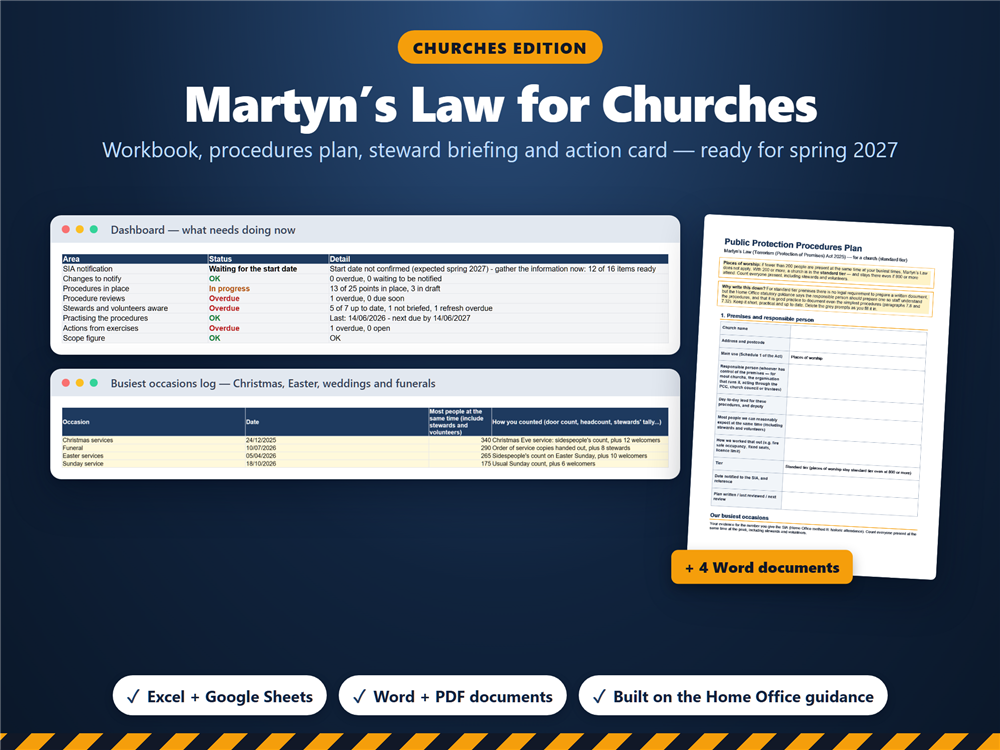
A 10-tab Excel and Google Sheets workbook with a busiest occasions log for Christmas, Easter, weddings and funerals, the 22 points to consider for the four procedures plus 3 for churches, and a stewards’ briefing record. Plus a Procedures Plan, Steward and Volunteer Briefing, Action Card and SIA Notification Checklist in Word and PDF.
See the church template on Etsy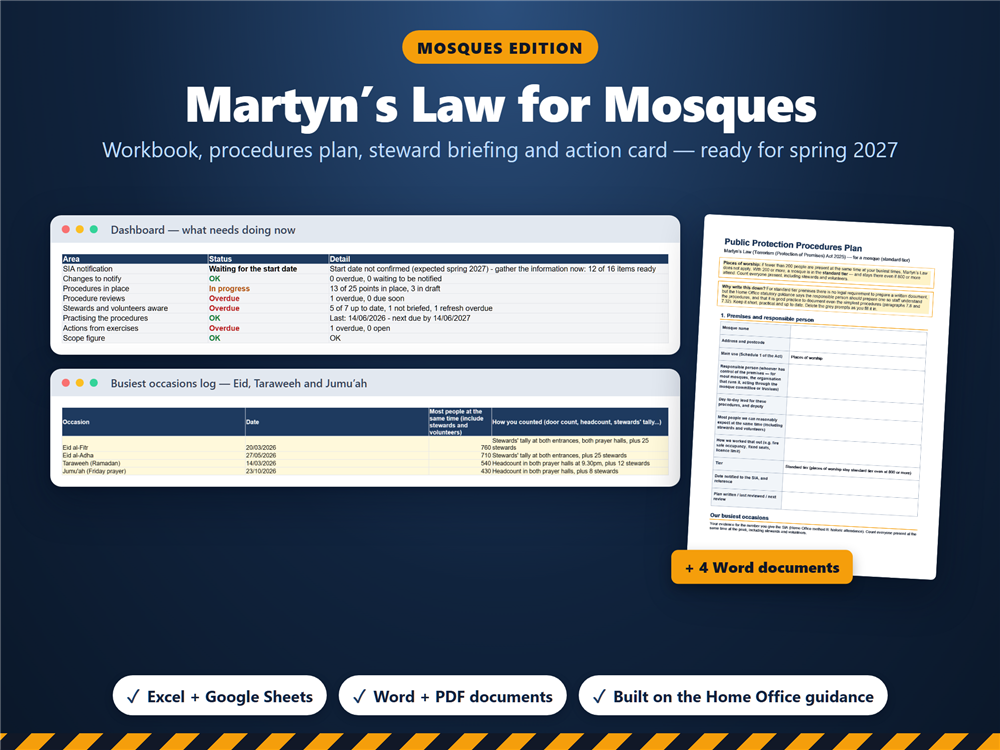
The same workbook and documents, written for a mosque: a busiest occasions log for Jumu’ah, Taraweeh and Eid, 3 extra points for separate prayer halls and entrances, stewarding and children attending classes, and a stewards’ briefing record.
See the mosque template on EtsyFor a gurdwara, temple, synagogue or other place of worship, our general Martyn’s Law Pack covers the same standard tier duties. See also our main guide: Martyn’s Law: does it apply to your premises?
Official sources
- GOV.UK: Understanding Martyn’s Law and the SIA’s role as regulator
- GOV.UK: Terrorism (Protection of Premises) Act 2025 — statutory guidance and supplementary documents
- GOV.UK: Faith security training
- GOV.UK: Protective security for faith communities
- GOV.UK: Protective Security for Mosques Scheme
- ProtectUK: free guidance and ACT Awareness e-learning