Home › Martyn’s Law › Places of worship › Mosques
Martyn’s Law for mosques: a guide for committees and trustees
Martyn’s Law applies to mosques where 200 or more people can be present at the same time. For many mosques that is decided by Jumu’ah, Taraweeh in Ramadan and the Eid prayers. Here is how to tell whether your mosque is in scope, how to count when there is more than one jama’ah, who is responsible, and what the law asks you to do.
The short version
- If fewer than 200 people are in the mosque at the same time, even at the busiest prayers, Martyn’s Law does not apply. Keep a note of your numbers to show it.
- With 200 or more, the mosque is in the standard tier, and it stays there however many attend.
- Count everyone in the building at the same time: every prayer hall, the sisters’ area, any upper floor, and the stewards and volunteers.
- Two Eid prayers? Count each jama’ah separately — it is the most people present together that matters, not the total for the day.
- Standard tier means two things: tell the SIA who is responsible, and have four simple procedures — evacuation, invacuation, lockdown and communication. No security equipment or building work is required.
Your busiest prayers decide it
The test is the most people you can reasonably expect in the mosque at the same time, “from time to time”. The guidance says that means occasionally — the threshold can be met only at certain times of the year and still count. It is not an average, so a quiet weekday doesn’t help if Eid fills the building.
The prayers to look at are usually:
- Jumu’ah
- Taraweeh in Ramadan, and the last ten nights
- Eid al-Fitr and Eid al-Adha
- Janazah prayers and large nikahs
- Talks, conferences and community events held in the prayer halls
Count everyone present: men, women and children, the imam, stewards and volunteers. If classes run at the same time as a prayer, the children and teachers count too. Only the parts of the building used as the mosque count — for example, a separately let shop on the ground floor would not.
More than one jama’ah, and overflow prayers
Many mosques hold two or three Eid prayers, or a second Jumu’ah, because the building can’t take everyone at once. The Act looks at people present at the same time, and the Home Office’s own example of a visitor attraction makes the point: 850 visitors in a day, but no more than 300 there at any one time, puts it in the standard tier on 300. So count each jama’ah on its own. Do allow for the changeover, though — if people for the second prayer arrive and wait inside before the first group has left, the busiest moment may be that overlap.
When the halls are full and people pray in the car park or on the pavement:
- Outside your premises (the public pavement or road): the guidance says people in the “immediate vicinity” aren’t counted towards the 200. But your procedures should still think about them — how they would be warned, and where they would go.
- Your own grounds, such as a yard or car park that is part of the mosque’s premises: treat people there as part of your count, and note how you decided. (The Home Office’s own café example counts its outdoor seating.)
- Prayers held somewhere else: the guidance gives the example of a community centre hall used as overspill for Friday prayers and Ramadan. The community centre is assessed on its own use and is responsible for its own premises — and because its main use isn’t worship, the places of worship rule doesn’t apply there. If you hire another venue, agree with its management how their procedures will work on the day.
Our guide to counting attendance at your busiest services goes through the counting step by step.
Who is the responsible person?
The Act puts the duties on the “responsible person”: the individual, organisation or company in control of the premises for their use as a place of worship. The guidance says this is set by the Act, “not a matter of choice”, and is usually an organisation rather than one person. For most mosques that will be the organisation that runs the building, acting through its management committee or trustees — not the imam personally. Control means the right and ability to decide how the building is used and who may stay on site; the guidance says the same idea is used in fire safety law, so whoever is responsible for your fire risk assessment is a good starting point.
The responsible person can share out the work — a head steward can run the procedures on the day — but can’t hand over the legal responsibility. If the mosque is hired out for an event, the guidance says the mosque stays responsible, but the hire agreement can require the hirer to help.
The four procedures in a mosque
Evacuation
Getting people out and away — dispersing in several directions rather than gathering at the fire assembly point. Plan for each prayer hall, the sisters’ area and any upper floor, and for shoes and crowded shoe racks slowing people at the doors.
Invacuation
Moving people to a safer place inside when the danger is outside — away from windows, glass and entrances. Check the space you choose can take your Eid or Jumu’ah numbers.
Lockdown
Securing doors so no one can get in. With separate entrances, decide who secures which door, and make sure exits still open so people can escape.
Communication
How everyone is told what to do — the PA in every hall, an announcement the whole congregation will understand, stewards at each entrance — and who calls 999.
Write the procedures down, even briefly. The guidance says the responsible person should, and that it may be hard to show compliance if the SIA inspects and nothing is written down. Check they fit your fire evacuation plan. For very large mosques, the guidance suggests also looking at the extra considerations written for bigger premises (paragraphs 8.2 to 8.6).
Stewards and volunteers
There is no requirement for formal counter-terrorism training. What the Act does need is that everyone with a part to play knows the procedures and their role — in most mosques, the stewards, the committee members on duty and anyone managing the doors or car park. A short briefing before Ramadan and before each Eid, with a list of who has been briefed and when, is a practical way to show it. Many mosques bring in extra volunteers for Eid, so brief them on the day too.
Free training and funding
- Faith Security Training from the Home Office is free for faith communities in England and Wales, with a module for Muslim communities. It suits stewards and committee members.
- ACT Awareness e-learning on ProtectUK is free and takes about 45 minutes.
- The Home Office’s Protective Security for Mosques Scheme can provide physical security, such as CCTV, alarms and fencing, and security staff, for mosques and associated Muslim community centres that are registered charities (or exempt). When we checked on 25 October 2026 it was open for applications. This is separate from Martyn’s Law, which doesn’t require physical measures at the standard tier.
What to do now
- Count your busiest prayers this year — Jumu’ah, Ramadan and Eid — and keep the figures with the date and how you counted.
- If the numbers stay under 200, keep the log — that is your evidence that you’re not in scope.
- If they reach 200, agree who the responsible person is and gather the details the SIA will ask for.
- Write short evacuation, invacuation, lockdown and communication procedures for each hall and entrance.
- Brief your stewards and volunteers, and note who has been briefed.
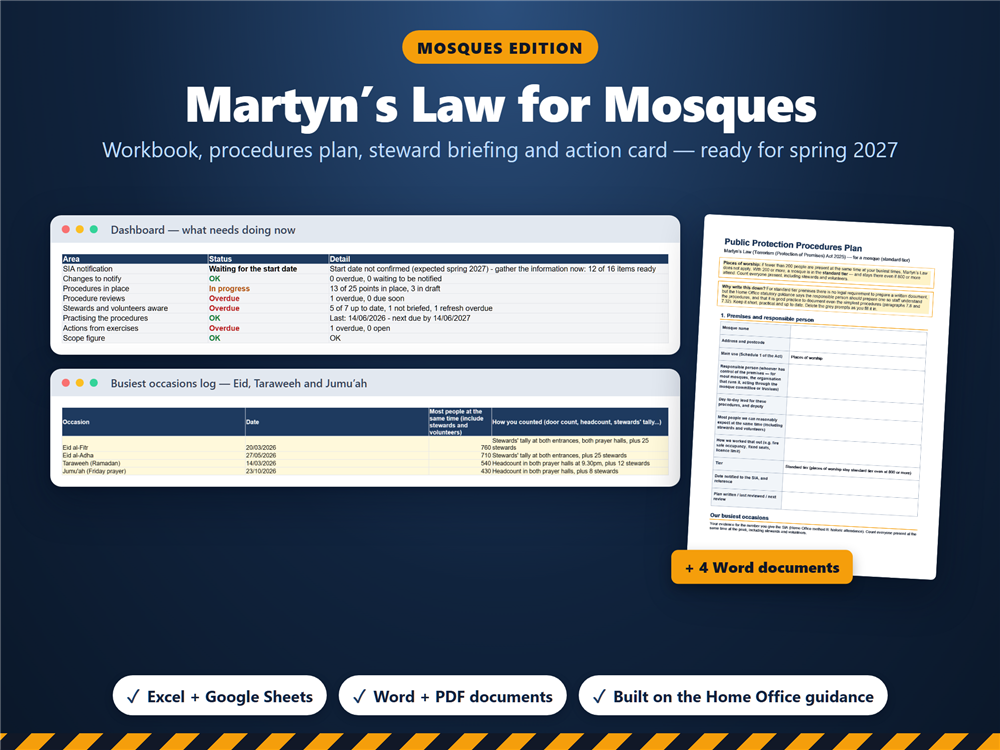
Our Martyn’s Law workbook for mosques has a busiest occasions log for Jumu’ah, Taraweeh and Eid that works out your tier, the 22 points the guidance asks you to consider plus 3 for mosques (separate prayer halls and entrances, stewarding at the busiest times, children attending classes), and a record of which stewards have been briefed. It comes with a Procedures Plan, Steward and Volunteer Briefing, Action Card and SIA Notification Checklist in Word and PDF.
See the mosque template on EtsyRelated: Martyn’s Law for churches, mosques and other places of worship · How to count attendance at your busiest services · Martyn’s Law: does it apply to your premises?
Official sources
- GOV.UK: Terrorism (Protection of Premises) Act 2025 — statutory guidance and supplementary documents
- legislation.gov.uk: Terrorism (Protection of Premises) Act 2025
- GOV.UK: Understanding Martyn’s Law and the SIA’s role as regulator
- GOV.UK: Faith security training
- GOV.UK: Protective Security for Mosques Scheme
- GOV.UK: Protective security for faith communities