Home › Trades & drivers › Mileage allowance
Mileage allowance for the self-employed (2026/27): rates, records and how to claim
If you’re a sole trader and use a car, van or motorbike for work, you can claim a flat rate for every business mile instead of adding up fuel, insurance and repairs. The car and van rate went up to 55p on 6 April 2026. Here’s how it works, the rules that catch people out, and what to keep.
The short version
- Cars and vans: 55p a mile for the first 10,000 business miles in the tax year, then 25p. Motorcycles: 24p. (Cars and vans were 45p before 6 April 2026.)
- The 10,000 miles are for all your cars and vans together, not for each vehicle.
- Add parking and tolls on business trips on top. The rate already covers fuel, insurance, repairs, road tax and the cost of the vehicle.
- Once you use the flat rate for a vehicle you must keep using it for that vehicle, and you can’t use it for a vehicle you’ve claimed capital allowances on.
- Keep a mileage log: date, where from and to, why, and the miles.
The rates for 2026/27
Under simplified expenses you multiply your business miles by a flat rate set by HMRC:
| Vehicle | First 10,000 business miles | Over 10,000 |
|---|---|---|
| Cars and goods vehicles (vans) | 55p (45p before 6 April 2026) | 25p |
| Motorcycles | 24p | 24p |
There’s no flat rate for bicycles under simplified expenses.
Your 2025/26 tax return, due by 31 January 2027, still uses 45p for the first 10,000 car and van miles. The 55p rate is for business miles from 6 April 2026, which go on your 2026/27 return.
10,000 miles across all your vehicles
This is the part people most often get wrong. The 55p rate covers the first 10,000 business miles in all the cars and vans you use the flat rate for in your business, added together in date order. It isn’t 10,000 miles for each vehicle.
An electrician does 8,000 business miles in a van and 4,000 in a car in 2026/27, both on the flat rate:
| Working | Claim | |
|---|---|---|
| Right: miles added together | 10,000 × 55p + 2,000 × 25p | £6,000 |
| Wrong: 10,000 per vehicle | 12,000 × 55p | £6,600 |
Because the miles count in date order, the switch to 25p happens on the trip that takes you past 10,000, whichever vehicle that trip is in. Motorcycle miles are separate: they’re always 24p and don’t count towards the 10,000.
Who can use the flat rate
- Sole traders and partnerships (with no limited company partners) can use simplified expenses for vehicles.
- Limited companies can’t. If you’re a director, mileage works differently, through the company.
- You choose for each vehicle. You can use the flat rate for one vehicle and actual costs for another.
Not sure which method is better for you? Our guide to van and car costs: mileage rate or actual costs has a worked comparison.
What counts as a business journey
- Yes: trips to customers and job sites, to suppliers and wholesalers, to temporary places of work, to training, and to your bank or accountant for the business.
- No: ordinary commuting between home and a permanent place of work, and private trips.
- If a trip mixes business and private stops, only count the business miles.
The rules that lock you in
- Once you’ve used the flat rate for a vehicle, you must keep using it for as long as you use that vehicle in your business.
- You can’t use the flat rate for a vehicle you’ve already claimed capital allowances on, or whose costs you’ve already claimed as an expense.
- You can make a fresh choice when you change vehicle.
- On the flat rate you can still claim parking and tolls on business trips, but not fuel, insurance, repairs, servicing, road tax, breakdown cover or capital allowances.
The records to keep
HMRC can ask how you worked out your claim, so keep a log of every business journey:
- the date;
- where you started and where you went;
- why (the customer, job or supplier);
- the business miles, and which vehicle you used.
Odometer readings at the start and end of the tax year are worth taking too, and you’ll need them for any vehicle on actual costs to work out its business use. Keep parking and toll receipts. Keep your records for at least 5 years after the 31 January filing deadline for that tax year.
A notebook in the glovebox is fine as long as you copy it up regularly. A spreadsheet adds it all up for you and shows where the 55p band runs out.
Where it goes on your tax return
Your flat-rate mileage goes in “Car, van and travel expenses” on the self-employment pages of your Self Assessment return: box 20 on the full pages (SA103F), under the same heading on the short pages. Add your parking and tolls for business trips to the same figure.
Making Tax Digital quarterly updates
If you’re in Making Tax Digital for Income Tax, your quarterly updates include your expenses by category, so your mileage claim goes in with car, van and travel expenses. Updates are cumulative: each one covers the tax year so far. With standard periods they’re due by 7 August, 7 November, 7 February and 7 May. Log your trips as you go and the quarterly totals are ready when you need them.
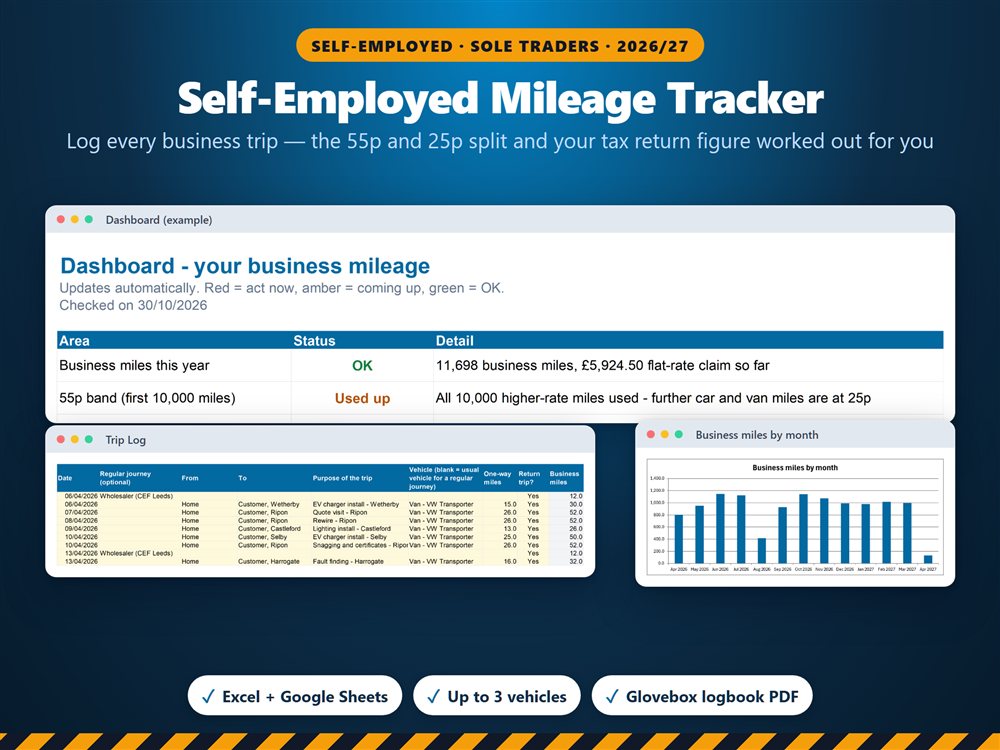
A trip log for up to 3 vehicles that works out the 55p and 25p split across all your cars and vans, gives you monthly and MTD quarterly totals, and prints a one-page summary for your accountant. Includes a printable glovebox logbook.
Mileage tracker on Etsy