Home › Trades & drivers › MTD for tradespeople
Making Tax Digital for plumbers, electricians and builders
Making Tax Digital for Income Tax started in April 2026 for sole traders with turnover over £50,000, and the threshold falls to £30,000 next April. If you work in the trades — often under CIS, with materials on every job — here’s what changes and how to get your records ready.
The short version
- If your gross turnover (before materials, expenses or CIS deductions) is over the threshold, you must keep digital records and send quarterly updates using compatible software.
- CIS deductions don’t reduce your turnover: count what you invoice, then claim the deductions back against your tax.
- Materials you buy for jobs are an allowable expense, but they still count in the gross price you charge.
- Watch the rolling 12-month VAT test: busy months can push you over £90,000 mid-year.
When MTD applies to you
HMRC looks at your qualifying income: your total self-employment and property income before expenses, from your tax return two years earlier.
| Qualifying income | In tax year | MTD from |
|---|---|---|
| Over £50,000 | 2024/25 | 6 April 2026 |
| Over £30,000 | 2025/26 | 6 April 2027 |
| Over £20,000 | 2026/27 | 6 April 2028 |
Partnerships aren’t in MTD for Income Tax yet. If you trade through a limited company, it doesn’t apply to you either — the company files Corporation Tax instead.
Quarterly updates and deadlines
Each update is a summary of your income and expenses by category for the quarter, sent from MTD-compatible software (or bridging software that links to a spreadsheet). They’re cumulative, so you can correct earlier quarters in the next one.
| Quarter (standard dates) | Update due |
|---|---|
| 6 April – 5 July | 7 August |
| 6 July – 5 October | 7 November |
| 6 October – 5 January | 7 February |
| 6 January – 5 April | 7 May |
You still file a final tax return by 31 January after the tax year, and pay your tax the same way as now.
CIS deductions
When you work for a contractor under the Construction Industry Scheme, they deduct tax from the labour part of your invoice — 20% if you’re registered for CIS, 30% if you’re not — and pay it to HMRC. Materials, and VAT, aren’t subject to the deduction. Some subcontractors qualify for gross payment status, with no deductions at all.
The deductions are advance payments towards your income tax and National Insurance. For your records:
- record the gross amount of each invoice as income;
- keep each contractor’s monthly CIS statement and record the deduction separately;
- claim the total in your tax return; if it’s more than your bill, HMRC repays the difference.
A quick check: if a deduction is more than 20% of the labour, ask the contractor whether they’ve verified you as registered.
Materials and job costs
Materials, subcontractor labour, skip and plant hire are allowable expenses in your accounts. Record them against each job too: it’s the only way to see which jobs actually made money and to price the next quote properly. Keep receipts (photos are fine) and supplier invoices.
Tools and equipment you keep are usually claimed as capital allowances; the annual investment allowance covers most purchases in full.
VAT registration
You must register for VAT if your VAT-taxable turnover for the last 12 months goes over £90,000. Check at the end of every month, not just at the tax year end. Register within 30 days of the end of the month you went over; you’re registered from the first day of the second month.
You must also register straight away if you expect to go over £90,000 in the next 30 days alone — for example a single large contract.
Once registered, most work for other VAT-registered CIS contractors falls under the domestic reverse charge: you don’t charge VAT, the contractor accounts for it. Work for homeowners is charged VAT as normal.
What records to keep
- every quote, invoice and payment, with dates;
- CIS payment and deduction statements from each contractor;
- receipts for materials, tools, van costs and other expenses;
- business mileage, if you use the flat rate (see van costs: mileage or actual);
- keep it all for at least 5 years after the 31 January filing deadline.
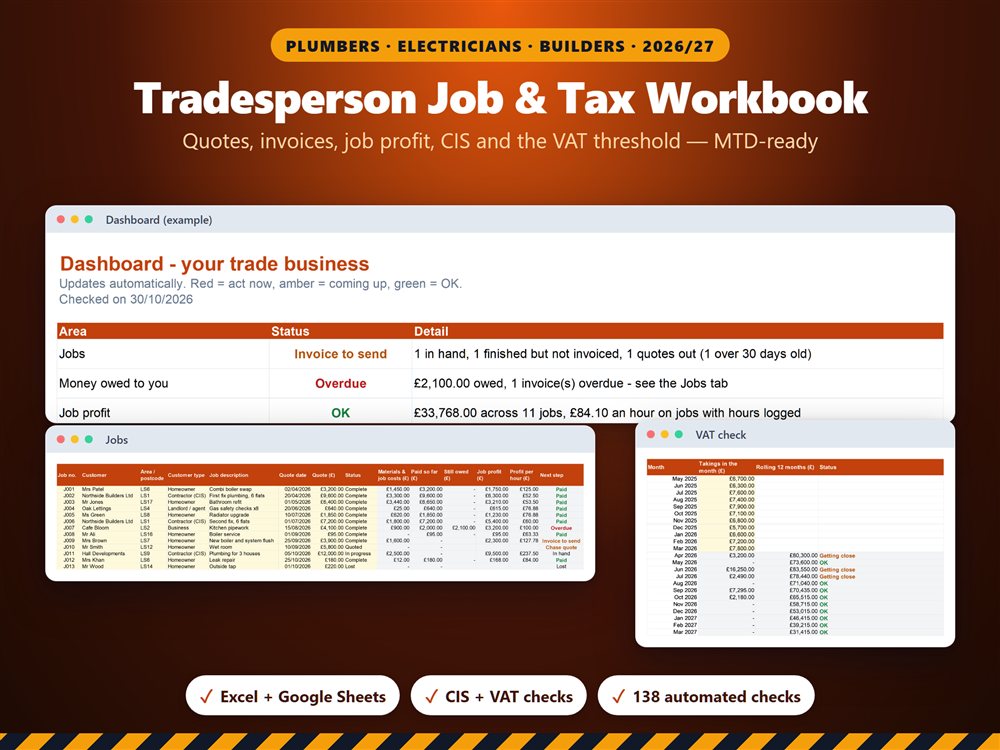
Track quotes and jobs from first enquiry to paid, with job profit and profit per hour, chase lists for overdue invoices, CIS deductions with a 20% check, a rolling 12-month VAT threshold test, and MTD quarterly totals ready to copy into your software. Excel and Google Sheets.
See the workbook on Etsy