Home › Trades & drivers › MTD for couriers
Making Tax Digital for couriers and delivery drivers
If you deliver for Uber Eats, Deliveroo, Just Eat, Amazon Flex, Evri or a local firm as a self-employed courier, you’re running a business in HMRC’s eyes. Making Tax Digital means quarterly updates once your turnover passes the threshold — and the apps already tell HMRC what they paid you.
The short version
- Your turnover is everything the apps pay you: delivery fees, tips and bonuses, across every platform, before their fees and your costs.
- Platforms report sellers’ earnings to HMRC, so make sure your records match their annual statements.
- Over the MTD threshold, you keep digital records and send quarterly updates.
- Your biggest cost is usually your vehicle: choose between the mileage rate and actual costs, and log your miles either way.
What counts as income
As a self-employed courier, all of these are business income:
- delivery fees from each app or client;
- tips, whether paid through the app or in cash;
- bonuses, boosts, incentives and referral payments.
Some platforms show your earnings after their service or equipment fees. For your records it’s cleaner to show the gross amount as income and the platform fees as an expense, so your figures match the statements the platforms send HMRC.
If you’re an employee or a worker on PAYE for a delivery company, none of this applies to that job — your employer handles the tax.
Platforms report to HMRC
Since 1 January 2024, digital platforms have had to collect details of people earning through them, including for services like deliveries and transport, and report what they paid to HMRC each year. They must also send you a copy. HMRC uses these reports to check tax returns and to find people who haven’t registered.
So once a year, compare each platform’s statement with your own total for that platform. If they don’t match, find out why before you file.
When MTD applies
HMRC looks at your qualifying income: gross self-employment and property income, before expenses, from your tax return two years earlier. Income from a PAYE job doesn’t count.
| Qualifying income | In tax year | MTD from |
|---|---|---|
| Over £50,000 | 2024/25 | 6 April 2026 |
| Over £30,000 | 2025/26 | 6 April 2027 |
| Over £20,000 | 2026/27 | 6 April 2028 |
A full-time courier earning £600 a week across apps has about £31,000 of turnover, so many will be in from April 2027.
Quarterly updates
You send a summary of income and expenses every quarter from MTD-compatible software (or bridging software that reads a spreadsheet). With standard dates, updates are due on 7 August, 7 November, 7 February and 7 May, and you still file a final return by 31 January. Weekly or fortnightly app payouts make this easier if you log them as they arrive.
What you can claim
- Your vehicle — either the mileage rate (55p a mile for the first 10,000 business miles by car or van, 25p after; 24p for motorbikes) or the business share of actual costs. See mileage or actual costs.
- Parking and tolls on deliveries (not fines), on top of either vehicle method.
- Platform fees, kit, insulated bags and phone holders.
- The business share of your phone and data.
- Hire and reward insurance — under actual costs, or as part of the mileage rate if you use that.
Miles from home to your first pickup zone and back can be harder to claim if you go to the same depot every day. App-based work where you start from home is usually treated as business travel from the moment you log on.
Records that make it easy
- each payout by platform, split into fees, tips and bonuses;
- your shifts with start and finish odometer readings or app mileage;
- receipts for vehicle costs, parking and kit;
- each platform’s annual statement;
- keep it all for at least 5 years after the 31 January filing deadline.
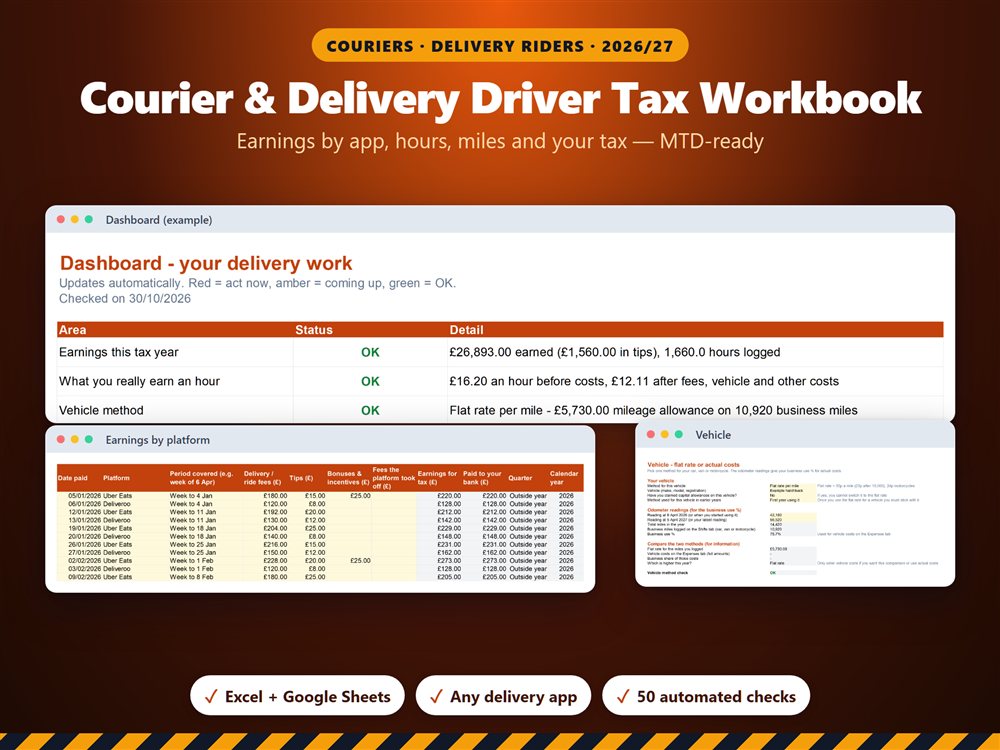
Log payouts by platform with fees, tips and bonuses, record shifts with hours and miles, compare the mileage rate with your actual vehicle costs, check your totals against each platform’s statement, and get MTD quarterly totals and your earnings per hour. Excel and Google Sheets.
See the workbook on Etsy