Home › Directors › Paying dividends
How to pay yourself a dividend properly
Dividends are how most small company owners take profit out. Done properly, they’re simple. Done carelessly — without the profits, the minute or the voucher — they can end up treated as a director’s loan. Here’s the routine, and the 2026/27 tax.
The short version
- Check the profits. A dividend can only be paid from profits available after Corporation Tax.
- Hold a board meeting and minute it, even if you’re the only director.
- Give each shareholder a voucher and keep a copy.
- Pay it to every shareholder of the class, in proportion to their shares.
- Know the tax: £500 allowance, then 10.75%, 35.75% or 39.35%.
Are there enough profits?
A company can only pay dividends out of profits available for distribution: broadly, the profits it has built up after tax, less any dividends already paid. That means:
- retained profits from your last accounts (the profit and loss reserve on the balance sheet), plus
- profit made since, after an allowance for Corporation Tax (19% on profits up to £50,000, 25% over £250,000, and marginal relief in between), less
- dividends already declared since those accounts.
Use up-to-date management accounts, not just the bank balance. Cash in the bank can be VAT, PAYE or Corporation Tax that’s already owed. A dividend paid without enough profits is unlawful, and shareholders who knew (or should have known) may have to pay it back. In practice HMRC may treat it as a director’s loan instead.
Board minutes, even for one director
GOV.UK is clear: you must hold a directors’ meeting to declare the dividend and keep minutes of the meeting, even if you’re the only director. The minute should record the profits figures the directors looked at, the amount per share, the payment date and the record date. Minutes must be kept for at least 10 years.
See our guide to board minutes and resolutions.
Dividend vouchers
For every dividend payment, write a voucher showing:
- the date;
- the company name;
- the names of the shareholders being paid;
- the amount of the dividend.
Give a copy to each shareholder and keep one for the company’s records. Most also show the number of shares, the amount per share and the share class.
Interim and final dividends
Under the Model Articles for private companies:
- Interim dividends are decided by the directors, at any time during the year, if the profits justify them.
- Final dividends are recommended by the directors after the accounts are approved, and declared by the shareholders by ordinary resolution. The shareholders can’t declare more than the directors recommend.
Most one- and two-person companies pay interim dividends through the year. If you have different share classes, each class can get a different dividend if your articles allow it.
Dividend tax for 2026/27
The company pays no tax on the dividend itself (it has already paid Corporation Tax on the profit). The shareholder pays income tax on dividends above the £500 allowance. Dividends sit on top of your other income, so salary uses up the bands first.
| Band (2026/27) | Dividend rate |
|---|---|
| Dividend allowance | 0% on the first £500 |
| Basic rate band | 10.75% (was 8.75%) |
| Higher rate band | 35.75% (was 33.75%) |
| Additional rate (over £125,140) | 39.35% |
Dividends can also use any Personal Allowance your other income hasn’t used. The Personal Allowance is reduced by £1 for every £2 of income over £100,000.
Telling HMRC
- Within the £500 allowance: nothing to report.
- Over £500 and up to £10,000: tell HMRC by 5 October after the tax year so it can change your tax code, or include it in a Self Assessment return if you already file one.
- Over £10,000: you need to file a Self Assessment return. Register by 5 October after the tax year if you don’t already have one.
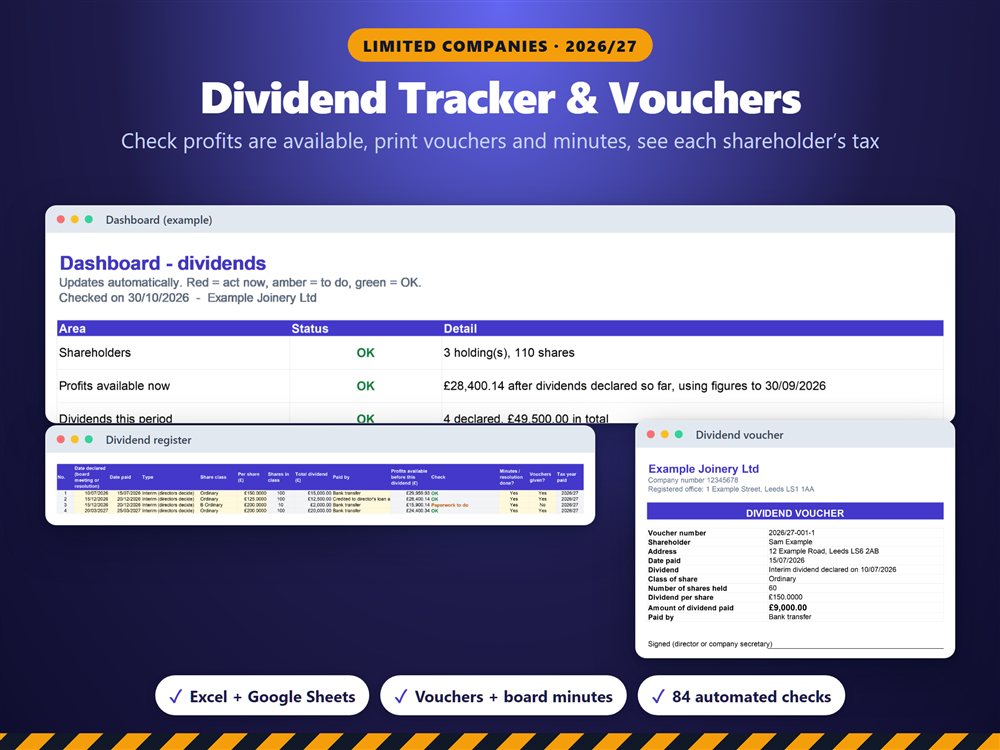
Checks the profits available before each dividend, flags anything paid without enough profit, fills in the voucher and board minute for you, and works out each shareholder’s dividend tax and what to tell HMRC. The Company Minutes & Resolutions Pack has Word versions of the minutes, final dividend resolution and vouchers.
Dividend tracker on Etsy Minutes pack on Etsy