Home › Directors › Board minutes and resolutions
Board minutes and resolutions for small companies
If your company is just you, or you and a partner, it’s easy to skip the paperwork. But the Companies Act still expects a record of directors’ decisions and shareholders’ resolutions, and your bank, accountant or a buyer may one day ask to see them.
The short version
- Every company must record minutes of all directors’ meetings and keep them for 10 years (s248).
- A sole director can decide without a meeting, but must keep a written record of each decision (Model Articles art 7 and 15).
- Shareholders of a private company can pass resolutions in writing instead of meeting (s288). Ordinary resolutions need more than half the votes.
- A written resolution lapses after 28 days unless your articles say otherwise (s297).
Directors’ meetings and minutes
Under the Model Articles, directors make decisions at a meeting or by a unanimous decision of all the eligible directors. Unless your directors have set a different number, at least two must take part for a meeting to be quorate (art 11).
Good minutes record:
- the date, place (or “by video call”), who attended and who chaired;
- that a quorum was present;
- any director’s interest in a proposed transaction, which must be declared before the company enters into it (s177);
- what was considered (accounts, quotes, contracts) and what was decided, in “it was resolved that” form;
- the chair’s signature, usually at the next meeting.
If you’re the only director
The Model Articles let a sole director take decisions alone (art 7(2)). The trade-off is that the company must keep a written record of every such decision for at least 10 years (art 15). A one-page signed record per decision is enough: the date, what you looked at, what you decided and any personal interest.
For dividends, GOV.UK still expects a minuted directors’ decision even with one director. See paying yourself a dividend properly.
Shareholders’ written resolutions
Private companies don’t need to hold general meetings for most decisions. A written resolution works like this:
- The directors send the resolution to every eligible shareholder at the same time, with a statement of how to agree to it and the date it must be passed by (s291).
- Shareholders sign and return it. An ordinary resolution passes when shareholders with more than half of the total voting rights have agreed; a special resolution needs 75%.
- If it hasn’t passed within 28 days of being sent out (or the period in your articles), it lapses (s297).
A written resolution can’t be used to remove a director or auditor before their term ends.
Which decisions need what
| Decision | Who decides | Record |
|---|---|---|
| Day-to-day running, contracts, bank mandates | Directors | Board minute or sole director record |
| Interim dividend | Directors | Board minute plus vouchers |
| Approving the annual accounts | Directors | Board minute; a director signs the balance sheet |
| Final dividend | Directors recommend, shareholders declare | Board minute plus ordinary resolution |
| Loan to a director over £10,000 | Shareholders, before the loan is made | Ordinary resolution plus memorandum (s197) |
| Appointing a director | Directors or shareholders (art 17) | Minute or resolution, then form AP01 with the new director’s Companies House personal code |
| Changing the articles or company name | Shareholders | Special resolution, filed at Companies House |
Keeping your minute book
- Board minutes: at least 10 years from the meeting (s248).
- Shareholders’ resolutions and minutes of general meetings: at least 10 years (s355).
- Number each minute and resolution and keep an index, in a binder or as signed PDFs in one folder.
- Some resolutions, including all special resolutions, must also be filed at Companies House within 15 days.
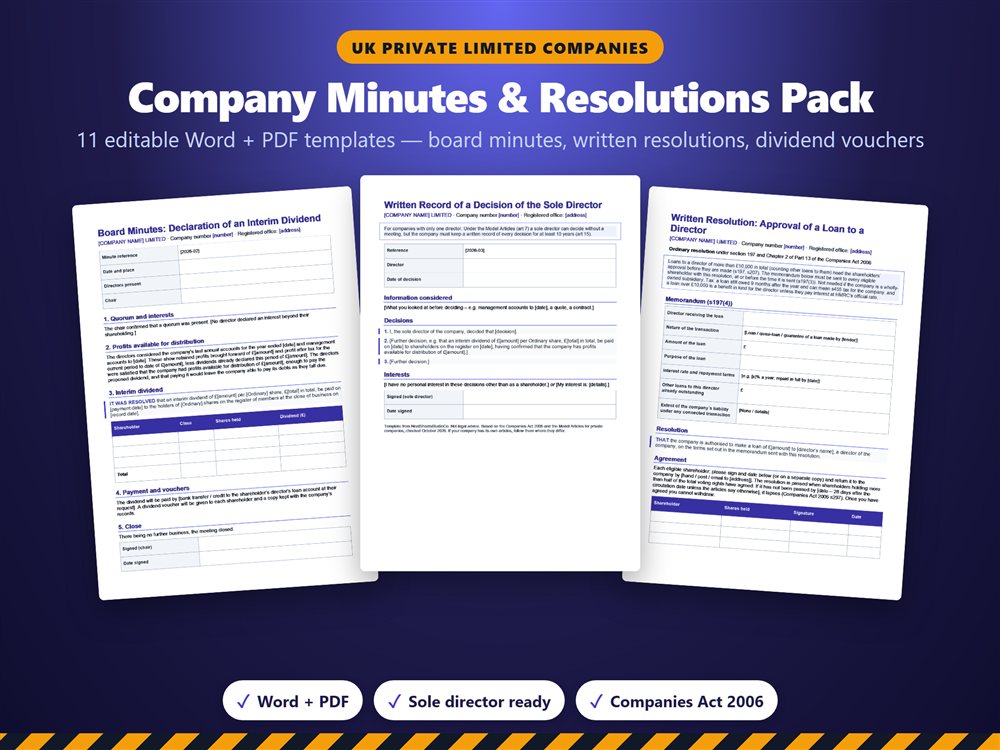
11 editable Word and PDF templates: general board minutes, interim dividend and annual accounts minutes, a sole director decision record, ordinary and final dividend written resolutions, approval of a director’s loan over £10,000 with the memorandum, change of directors, dividend vouchers and a minute book index.
See the pack on Etsy