Home › Childminders › Ofsted records
What records does Ofsted expect a childminder to keep?
A new EYFS statutory framework for childminders came into force in September 2026. Here is a plain-English checklist of the records, policies and notifications it requires — and, just as usefully, what it says you don’t have to write down.
The short version
- Keep information about every child (3.98) and a daily register with hours of attendance (3.103).
- Record every accident, injury and first aid, every medicine given, and any physical intervention, and tell parents the same day.
- Keep a complaints record, reply to written complaints within 28 days, and show the record to Ofsted on request.
- Tell Ofsted (or your childminder agency) about serious incidents within 14 days.
- Write the progress check at age two. Day-to-day observations don’t need to be written down.
Information about each child
For every child you look after you must hold (3.98):
- full name and date of birth;
- the name and address of every known parent or carer, and which of them the child normally lives with;
- anyone else with parental responsibility;
- emergency contact details — more than two numbers where possible.
Before a child starts you must also find out about dietary needs, allergies, intolerances and health needs (3.64), and agree allergy action plans with parents where needed (3.65). You may only release a child to people the parent has told you about (3.88), so a list of who may collect is essential.
The daily register and ratios
You must keep a daily record of the names of the children you look after, their hours of attendance and the names of their key person, if that isn’t you (3.103). You also need the name, address and phone number of anyone who lives or works on the premises, or is regularly in unsupervised contact with the children.
The ratios (3.49–3.53) are easier to show with a good register:
- no more than six children under eight per person caring for children, including your own children;
- of those, no more than three young children — a child is a young child until 31 August after their fifth birthday;
- normally only one child under one.
Exceptions are allowed (for example siblings, your own baby, continuity of care, or older children only before and after school) if you can show every child’s needs are met — but the limit of six under-eights per person always applies. If you go over the usual numbers, note why.
Accidents, medicines and food
- Accidents and first aid: record every accident or injury and any first aid given, and tell parents the same day or as soon as reasonably practicable (3.77). An “existing injury” form for injuries a child arrives with is good practice.
- Medicines: only with written permission from the parent for that particular medicine; record each dose and tell the parent the same day (3.61).
- Physical intervention: if you ever have to use reasonable force to prevent injury, record it and tell the parent the same day (3.75).
- Paediatric first aid: you must hold a full certificate at all times, renewed every three years (3.42).
- Food: register with your local council as a food business if you provide food.
Complaints
Keep a written record of complaints and their outcome. Investigate written complaints about how you meet the EYFS and tell the person the outcome within 28 days. Ofsted (or your agency) can ask to see the record (3.100), and you must tell parents how to contact Ofsted if they believe you aren’t meeting the requirements (3.101).
What to tell Ofsted, and when
| What happened | Deadline |
|---|---|
| Serious accident, illness or injury to, or death of, a child in your care (3.78) — also tell local child protection agencies | As soon as reasonably practicable, within 14 days |
| Allegation of harm or abuse by anyone living, working or looking after children at the premises, and what you did about it (3.11) | As soon as reasonably practicable, within 14 days |
| Food poisoning affecting two or more children (3.72) | As soon as reasonably practicable, within 14 days |
| Significant events affecting your suitability, or anyone’s in regular contact with children — for example a new adult in the household, a change of address, a child going missing, or a relevant health change | As soon as possible, within 14 days |
Failing to notify some of these without a reasonable excuse is an offence. Ofsted’s guidance “Childcare: significant events to notify Ofsted about” gives many examples. If you’re registered with a childminder agency, tell the agency instead.
Policies
If you’re registered only on the Early Years Register (or with an early years agency), you don’t have to have written policies — but you must be able to explain them to parents, Ofsted and others, and make sure any assistant follows them (3.6). Your safeguarding policy must cover concerns about a child, allegations, phones and cameras, checking new staff, and training (3.7).
One policy you must share with parents is your attendance policy: how parents report absences, and what you’ll do if a child is absent without notice or for a long time (3.13). You must also give parents information about how you deliver the EYFS, your staffing, food, SEND support and your policies (3.99).
The 2026 framework also sets out detailed safer sleep rules for children under two (3.86) — including that babies 12 months and under only sleep in a cot, and babies under six months always have an adult in the same room.
Assessment and the progress check at two
The framework is clear that assessment shouldn’t mean long breaks from children or excessive paperwork, and that you don’t have to keep written records of day-to-day observations (2.2, 2.4). What you must do is the progress check at age two: between two and three, give parents a short written summary of their child’s development in the prime areas, highlighting strengths, areas where extra support might help and any concern about a possible delay (2.5–2.7).
Keeping records safe
Records must be easy to get to but stored securely, and only seen by people with a right or professional need to see them (3.95). Parents can see the records about their own child (3.96). Keep records for a reasonable time after a child leaves (3.97). If you hold personal information you’ll usually need to pay the ICO data protection fee.
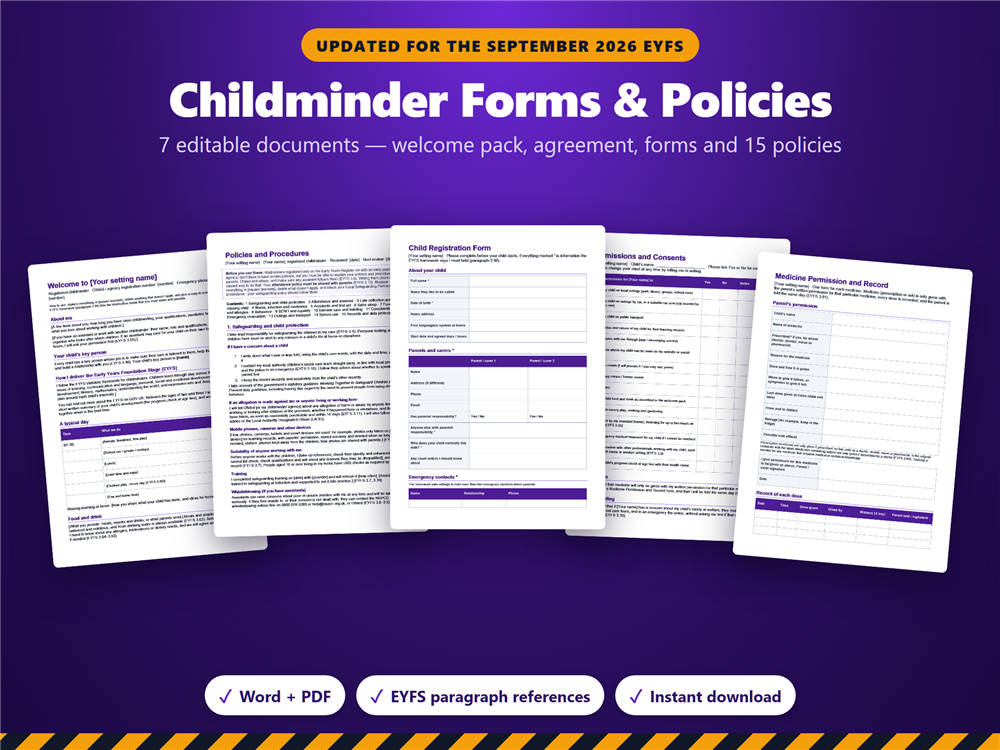
Our Childminder Forms & Policies pack has a parent welcome pack, childcare agreement, registration form, permissions, accident and medicine records and 15 editable policies, in Word and PDF. The Childminder Business & Ofsted Records Workbook keeps the register with a ratio check, tracks every deadline, and does your accounts.
Forms & policies on Etsy Records workbook on EtsyRelated: Childminders and Making Tax Digital: the 10% and hours method ends