Home › Childminders › Making Tax Digital
Childminders and Making Tax Digital: the 10% and hours method ends
For decades, childminders have used a simple method agreed with HMRC to work out their expenses: 10% of income for wear and tear, a share of household bills based on the hours they work, and estimated food costs. In March 2026 HMRC updated its guidance — and once you’re in Making Tax Digital, that method is no longer available. Here’s who it affects, when, and what to do instead.
The short version
- HMRC’s childminder method (10% wear and tear, household costs by hours worked, food estimates, no receipts under £10) still applies only if you are not in Making Tax Digital.
- Once you’re in MTD, you use the normal rules: actual costs, a fair share of household bills, and digital records of every cost.
- MTD applies if your gross self-employment and property income is over £50,000 (from April 2026), £30,000 (from April 2027) or £20,000 (from April 2028), based on an earlier year’s return.
- “Gross income” is before expenses — it includes parents’ fees, Tax-Free Childcare payments and funded hours from the council.
The childminder method, explained
In 1986 HMRC (then the Inland Revenue) agreed a simpler way for childminders to work out expenses with the National Childminding Association, now Coram PACEY. HMRC’s manual (BIM52751) still sets it out:
- Wear and tear: deduct 10% of your childminding income from your own home to cover furniture and household items. If you claim this, you can’t also claim the cost of replacing those items.
- Household costs by hours: claim a share of running costs (such as heat, light and cleaning) and fixed costs (such as council tax, rent or mortgage interest and insurance) based on the hours you look after children, not the number of children.
- Food: a reasonable estimate of food and drink for the children you look after, without receipts.
- Receipts: not needed for items under £10 (unless several are bought together totalling £10 or more).
| Hours a week looking after children | Share of running costs | Share of fixed costs |
|---|---|---|
| 10 | 9% | 3% |
| 20 | 17% | 5% |
| 30 | 25% | 8% |
| 40 or more (full time) | 33% | 10% |
From HMRC’s table in BIM52751, which also gives the 15, 25 and 35 hour rows. Only hours worked from your own home count.
What changed in March 2026
HMRC updated BIM52751 to deal with two changes: childminders who work outside the home, and Making Tax Digital. On MTD it is clear: from April 2026 the guidance does not apply to childminders within MTD. They follow the normal rules for expenses and record-keeping that apply to every other business, and must not use the 10% deduction, the hours table, food estimates or the receipt rule.
HMRC’s reasoning is that the normal rules let childminders deduct all their allowable costs, including a share of costs that are only partly for the business — and that actual costs may give more accurate relief. For some childminders, claiming actual costs will give a bigger deduction than the old method; for others it will be smaller. It’s worth working out both while you still have the choice.
If you also work from non-domestic premises (a hall or community building), the 10% and hours method only ever applied to the part of your work done from your own home. Venue hire and other costs there are claimed as normal.
When Making Tax Digital applies to you
MTD for Income Tax depends on your qualifying income: your total self-employment and property income before expenses, from an earlier tax return.
| If your qualifying income was over… | …on your return for | You start MTD on |
|---|---|---|
| £50,000 | 2024 to 2025 | 6 April 2026 |
| £30,000 | 2025 to 2026 | 6 April 2027 |
| £20,000 | 2026 to 2027 | 6 April 2028 |
For a childminder, that income includes fees from parents, Tax-Free Childcare and childcare voucher payments, and payments from the council for funded hours. A full-time childminder with three or four children can easily pass £30,000 — which means many will need to change how they claim expenses from April 2027 or 2028. Use our free MTD start date checker or read the full Making Tax Digital guide.
What to claim instead
- Household costs: a fair, consistent share of your actual bills. HMRC splits them into fixed costs (council tax, mortgage interest, rent, insurance, general repairs) and running costs (heat, light, cleaning, metered water), and expects the share to reflect how much of your home you use, and for how long. Write down how you worked it out.
- Or the flat rate: the simplified expenses flat rate for working from home is £10 a month for 25–50 hours, £18 for 51–100 hours and £26 for 101 hours or more. For most full-time childminders this will be much less than a share of actual costs.
- Furniture and equipment: the actual cost of things you buy for the business, as expenses or capital allowances, instead of 10% of income.
- Food: the actual cost of food and drink for the children you look after, with records.
- Everything else is the same: toys and resources, outings, insurance, training, Ofsted and membership fees, the business share of your phone, and mileage — at the 2026/27 rate of 55p a mile for the first 10,000 business miles, then 25p.
Records and receipts in MTD
In MTD you keep digital records of every income and expense item and send quarterly updates to HMRC using MTD-compatible software, then a final return after the year end. The quarters run 6 April to 5 July, 6 July to 5 October, 6 October to 5 January and 6 January to 5 April. Keep a photo or scan of receipts — including small ones, as the £10 rule no longer applies.
What to do now
- Check your gross income for 2025/26 and estimate 2026/27, including funded hours, to see when MTD starts for you.
- If you’re not in MTD yet, you can keep using the childminder method — but start keeping receipts and household bills now, so you’re ready.
- Work out your expenses both ways this year to see which gives the better result.
- Choose MTD-compatible software (or a spreadsheet plus bridging software) before your start date.
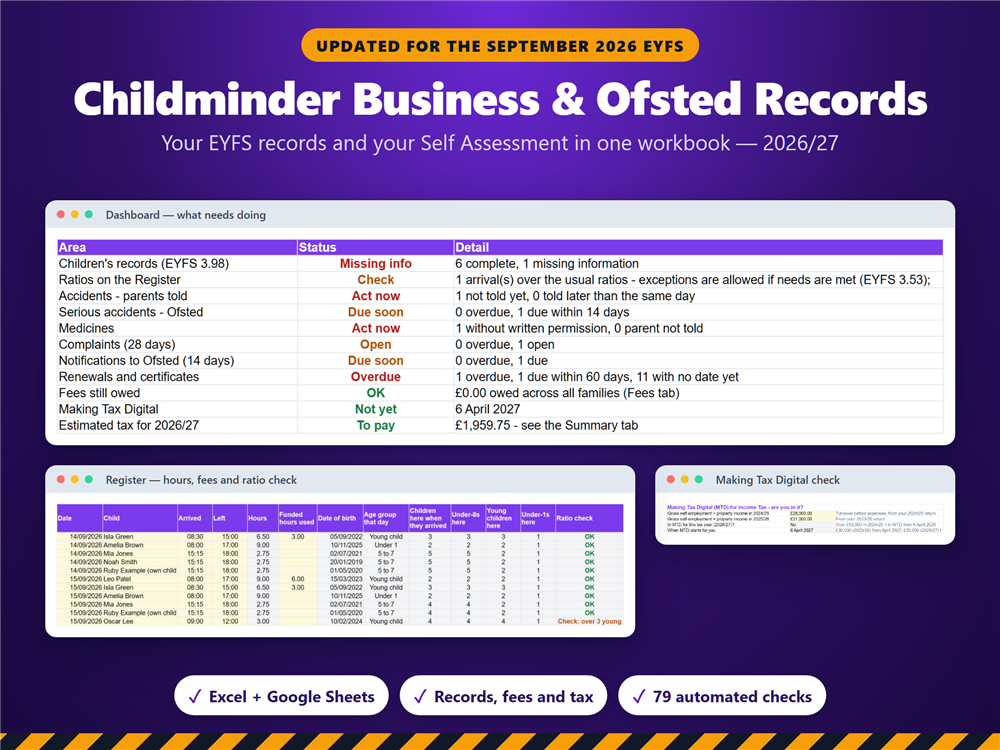
Our Childminder Business & Ofsted Records Workbook checks when MTD starts for you and switches the 10% and hours method off automatically if you’re in it. It gives MTD quarterly totals and a tax estimate, and keeps your EYFS register, ratios, accident and medicine records and renewals in the same file.
See the template on EtsyRelated: What records Ofsted expects a childminder to keep · Making Tax Digital guide