DBS checks for self-employed tutors: the 2026 route
For years, self-employed tutors were told they couldn’t get their own enhanced DBS check. That changed in January 2026. Here’s who can apply, how, what it costs now, and what parents are being told to ask you for.
The short version
- Since 21 January 2026, a self-employed tutor applies for their own enhanced DBS check through a DBS umbrella body.
- A private tutor working with children is GOV.UK’s own example of someone who can get an enhanced check with the children’s barred list.
- Parents can’t apply for you — but they’re now being encouraged to ask to see your certificate.
- Join the Update Service within 30 days and families can check your certificate is still current, free, with your permission.
What changed in 2026
An enhanced DBS check used to need an organisation to ask for it, so a tutor working for themselves had no way to get one unless they also worked for a school or agency. Many could only get a basic check, which shows unspent convictions but not barred list information.
New GOV.UK guidance, live from 21 January 2026, says self-employed people and personal employees can now apply for their own Enhanced or Enhanced with Barred List(s) check through a DBS umbrella body. The eligibility rules themselves haven’t changed: what’s new is that you can apply directly.
If you tutor through an agency or a school, they may still apply for you under their own policies.
Are you eligible?
An enhanced check is only available for roles that qualify under the DBS rules. GOV.UK’s worked example is a self-employed maths tutor teaching children two evenings a week, who can apply for an Enhanced with Barred List check in the child workforce. Tutors who only teach adults may be eligible for a different level of check, or only a basic check. Use the DBS eligibility guidance on GOV.UK, and the umbrella body will also check your role before submitting.
Someone on the children’s barred list commits a criminal offence if they carry out regulated activity with children, and so does anyone who knowingly employs them to do so.
How to apply
- Check your role is eligible using the DBS guidance.
- Choose an umbrella body with GOV.UK’s “Find an umbrella body” tool, filtering for ones that process checks for self-employed people.
- Prove your identity. The umbrella body checks your documents under the DBS ID checking rules.
- Decide on the Update Service. You can join while your application is in progress, using its reference number.
- Your certificate comes by post. It’s yours: you choose who sees it.
In Scotland the equivalent is a PVG check from Disclosure Scotland, and in Northern Ireland it’s AccessNI.
What it costs
| Item | Fee from 5 October 2026 |
|---|---|
| Enhanced DBS check (with or without barred list) | £41.00 (was £49.50) |
| Umbrella body administration fee | Set by the umbrella body |
| DBS Update Service | £15.00 a year (was £16.00) |
| Status check by a parent or organisation | Free |
As a self-employed tutor, the cost of your DBS check and Update Service subscription is a business expense.
The Update Service
A DBS certificate has no official expiry date, so families and agencies will look at how old yours is. The Update Service keeps it current: you pay £15 a year, and anyone legally entitled to see your certificate can do a free online status check, with your permission, to see whether anything has changed since it was issued.
- Join while applying, with your application reference number, or within 30 days of the certificate being issued, with the certificate number. Miss that and you’ll need a new check to join.
- The subscription lasts a year. You can renew up to 30 days before it ends, but not on the last day.
What parents will ask for
The DBS has published a guide for parents hiring self-employed tutors and is running a campaign to promote it. Parents are told to:
- ask whether you’re willing to share an enhanced certificate, and accept that the choice is yours;
- look at the original certificate, not a photo or copy;
- check that the name matches your photo ID, that it’s for the children’s workforce, and when it was issued;
- do an Update Service check if you’ve joined;
- treat it as one part of the picture, alongside references, qualifications and experience. The guidance says it’s “not a pass or fail test”.
Saying all this clearly in your terms and conditions before the first lesson helps families trust you, and saves an awkward conversation.
Keeping track
A DBS check is one of several things a tutor needs to keep up to date. Others include public liability or professional indemnity insurance, safeguarding training, the ICO data protection fee if you hold students’ details, and business use on your car insurance if you drive to lessons.
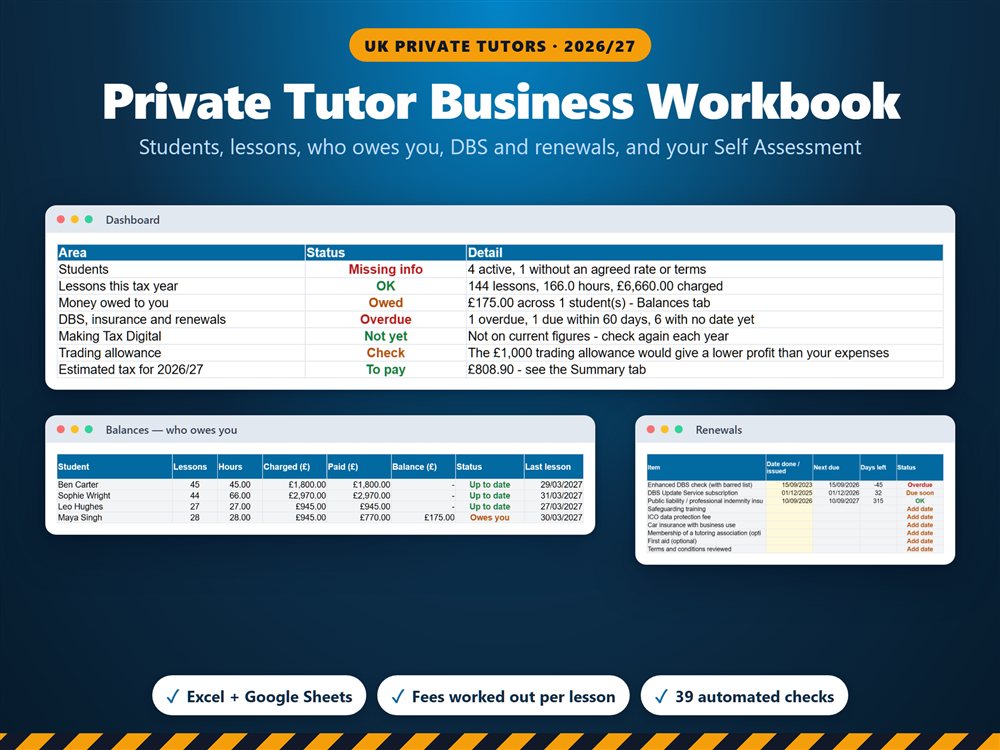
Our Private Tutor Business Workbook tracks your DBS, Update Service, insurance and other renewal dates, logs lessons, shows who owes you and works out your tax. The Tutor Forms Pack has editable terms (including a DBS and safeguarding section), an intake and consent form, a progress report and an invoice.
Tutor workbook on Etsy Tutor forms on Etsy