Home › Health practitioners › HCPC CPD audit
HCPC CPD audit: what to submit if you’re selected
Physiotherapists, podiatrists, OTs, paramedics and the rest of the HCPC’s professions all confirm at renewal that they meet the CPD standards. A small number are asked to prove it. Here’s what that involves, and how to be ready.
The short version
- At each renewal, the HCPC randomly selects 2.5% of each profession. People registered for under two years aren’t selected.
- If you’re picked, you send a CPD profile: a summary of your practice, a dated list of activities, a statement against the standards and evidence.
- There’s no set number of hours. What matters is a continuous record, a mix of activities, and the difference your CPD made.
- Explain any gap of three months or more in your CPD.
The five CPD standards
Every registrant must:
- keep a continuous, up-to-date and accurate record of their CPD activities;
- show that their CPD is a mixture of learning activities relevant to current or future practice;
- seek to ensure their CPD has contributed to the quality of their practice and service delivery;
- seek to ensure their CPD benefits the service user;
- present a written profile, with evidence, if asked.
What the profile contains
| Part | What to include |
|---|---|
| Summary of practice history | Up to 500 words on the last two years: your role, main responsibilities, specialist areas and who you work with |
| Dated list of CPD activities | Everything since you last renewed, with dates (start and end dates for activities over a period) |
| Statement | Up to 1,500 words on how you meet standards 1 to 4. Choose several activities and say what you did, what you learnt, what you now do differently and who benefited |
| Evidence | Proof of the activities in your statement – the HCPC would expect at least four pieces. Remove anything that could identify a service user |
The HCPC treats the word counts as a guide rather than a hard limit. It aims to process profiles in eight to twelve weeks, and your registration isn’t affected while it does, as long as you have renewed and paid.
Types of CPD activity
To show a mixture (standard 2), use more than one kind of learning. The HCPC groups activities as:
- work-based learning – for example case reviews, in-service training, reflective practice;
- professional activity – for example supervising students, audit, presenting;
- formal or educational – courses, study days, conferences;
- self-directed learning – reading, online modules;
- other – for example relevant voluntary work.
How to stay audit-ready
- Log each activity as you go, with what changed in your practice and who benefited – it’s much harder to reconstruct two years later.
- Give each piece of evidence a reference number and note where it’s saved.
- Watch for gaps of three months or more, and note the reason (illness, leave, a career break).
- Keep your professional indemnity in place: it’s a condition of HCPC registration, and private work needs its own cover.
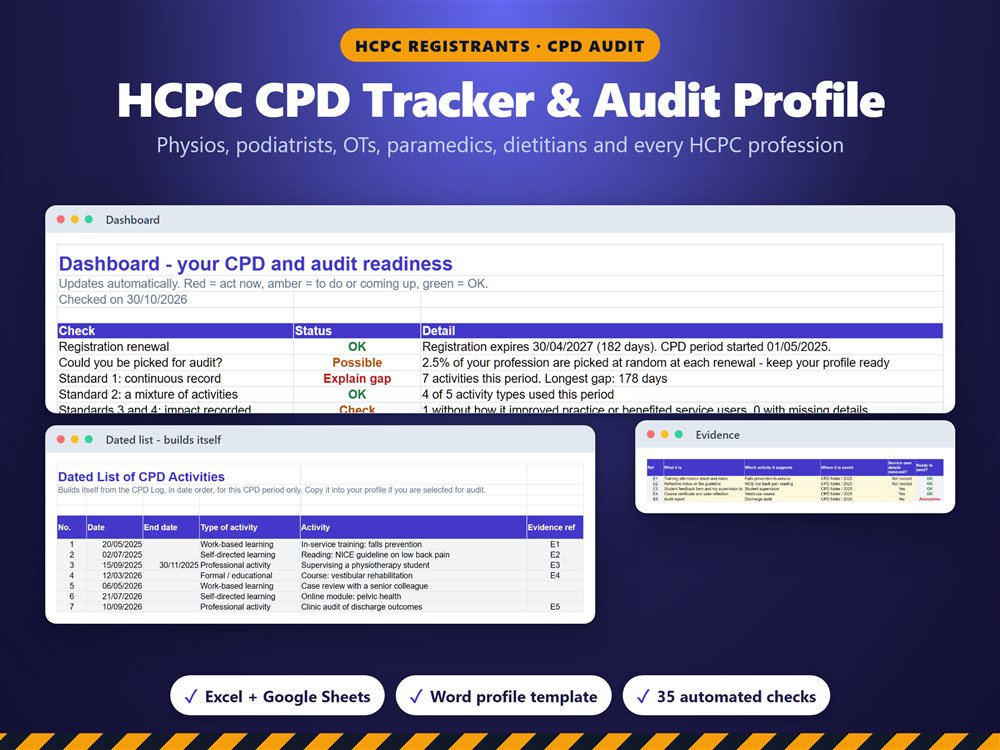
Our HCPC CPD Tracker & Audit Profile Builder logs your CPD with its impact, checks it against the standards, flags gaps, builds your dated list automatically and has a profile planner with live word counts – plus a Word profile template.
HCPC CPD Tracker on Etsy