Home › Transport › External TM pack
Why an external transport manager needs a proper ETM pack
An external transport manager is named on another business's operator licence, often for a few hours a week. When something goes wrong, the traffic commissioner will ask the operator and the TM to show that the TM was really in control. An ETM pack is the set of records and documents that lets you do that.
 EXTERNAL TRANSPORT MANAGERS
The short version
- SD3 says a transport manager must exercise continuous and effective management, not be one “in name only”.
- An external TM needs a written contract setting out their tasks, made directly with the operator, and can act for no more than 4 operators and 50 vehicles.
- Most of the TM's job is checking the operator's systems: inspections, brake tests, defects, tyres, drivers and tachographs. Each check needs a record.
- If the operator ignores your advice, SD3 says you must first notify the operator in writing.
1. What SD3 and traffic commissioners expect
Statutory Document 3 is the Senior Traffic Commissioner's guidance on transport managers. It quotes the Upper Tribunal's view that the need for “a proper, active transport manager” is a serious requirement, not a formality. It lists the kinds of task a TM is expected to manage, grouped into three areas:
| Area | What the TM is expected to manage (SD3 section 2.6, summarised) |
|---|---|
| Compliance | Managing, auditing and reviewing compliance systems; keeping up to date with changes in the rules |
| Drivers | Licence checks, Driver CPC, drivers' hours and tachographs, training, defect reporting |
| Vehicles | Maintenance arrangements, prohibitions and annual test failures, fleet specification, insurance, the maintenance planner |
The TM keeps ultimate responsibility for these tasks within their declared hours, even where some of the work is delegated. For an external TM, Article 4 of Regulation 1071/2009 (kept in UK law) adds that the contract should set out tasks such as managing vehicle maintenance, checking transport contracts and documents, assigning loads or services to drivers and vehicles, and checking safety procedures.
2. What goes wrong at public inquiries
A public inquiry usually follows a DVSA investigation, a run of prohibitions or a maintenance failure. The TM is called alongside the operator, and their own good repute is at stake. The case law summarised in SD3 shows the same problems coming up again and again:
- A TM in name only. A TM who is nominated but can't show what they actually did puts their repute at risk. Without visit notes, audit reports or written advice, it's hard to show otherwise.
- Not enough time. Traffic commissioners look at the hours the TM really gives the operator, their other commitments and the contract. Not giving the minimum hours committed to is treated as unacceptable (SD3 cites Alec Hayden, Trans Consult, 2006/252).
- Advice given only by word of mouth. If the operator overrode the TM, the TM should have raised it in writing, and may need to resign rather than stay nominated (SD3 cites J D Cowan & A Fenny, 2003/258).
- “I delegated it.” Delegating tasks doesn't move the responsibility (SD3 cites Adrian Dalton, 2016/059).
- Changes not reported. Reductions in hours and resignations must be reported to the traffic commissioner (SD3 cites Richard Heard, 2014/085).
- A consultancy package. SD3 warns against tying a TM appointment to a consultancy service (it cites Russet Red Ltd, 2012/013).
Where a TM loses their good repute, the traffic commissioner must disqualify them from acting as a transport manager, and the operator may lose its licence if it can't appoint a replacement in time.
Every case turns on its own facts, and good records don't guarantee an outcome. If you're called to a public inquiry, consider getting advice from a specialist transport solicitor.
3. The contract
SD3 says an external TM is engaged under a contract that specifies the tasks they will perform, and that it should be directly between the operator and the TM. A good contract covers:
- DutiesMaintenance, defects, tyres, drivers, tachographs, documents and audits
- AuthorityTo take vehicles off the road and stop drivers
- Hours and visitsMatching the hours declared to the traffic commissioner
- Reporting and escalationMonthly written reports, and written notice if advice is ignored
- Access to recordsPremises, vehicles, maintenance and tachograph data
- Fees, notice and the TCEnding the agreement, and telling the traffic commissioner within 28 days
4. Maintenance: inspections, brake tests and defects
The DVSA Guide to maintaining roadworthiness sets out what a good maintenance system looks like. The points an external TM should check, and record that they checked, include:
| What | DVSA guidance |
|---|---|
| Safety inspection intervals | Usually between 4 and 13 weeks, depending on the vehicle and its work; 6 weeks for vehicles or trailers 12 years or older. Plan them at least 6 months ahead |
| Brake performance | An assessment at every safety inspection; a laden roller brake test is the most effective method. Without electronic monitoring (EBPMS), at least 4 laden tests a year, spread evenly |
| Driver walkaround check | Before the vehicle is used, at least once every 24 hours it's in service, with defects reported in writing |
| Dangerous defects | The vehicle must not be used until it's repaired |
| Records | Inspection, brake test and defect records kept for at least 15 months |
Inspection intervals on the licence are counted in ISO weeks, so a 6-weekly inspection is on time if it falls in the right week.
5. Tyres, including the 10-year rule
- Since 1 February 2021, tyres aged 10 years or more must not be used on the front steered axle of an HGV, bus or coach (or on single wheels fitted to a minibus).
- The tyre's date code must be legible. For a retread, the age runs from the date it was retreaded.
- DVSA guidance says a tyre aged 9 years should be noted on the safety inspection record. On other axles, older tyres need their age recorded and a risk assessment.
- Vehicles over 3.5 tonnes need at least 1mm of tread across three-quarters of the breadth, all the way round; vans up to 3.5 tonnes need 1.6mm.
- Pressures should be checked and recorded as found, and wheel nut re-torque checks recorded after a wheel is refitted.
The simplest way to stay on top of this is a tyre register: one line per tyre with its position, date code, age, tread depth and condition, updated at every inspection.
6. Drivers and tachographs
- Check driving licences on a schedule that suits each driver's risk (GOV.UK sets no fixed frequency).
- Track Driver CPC: 35 hours of periodic training every 5 years.
- Download driver cards at least every 28 days and vehicle units at least every 90 days, analyse the data, and debrief drivers about infringements. See our tachograph downloads guide.
- Toolbox talks and briefings count as evidence of training. See why toolbox talks matter.
7. Your hours, visits and reports
SD3 Annex A gives indicative weekly hours by fleet size as a starting point: for example 4 to 8 hours a week for 3 to 5 vehicles, and 12 to 20 hours for 11 to 14 vehicles. Log the time you spend on each operator, your site visits and the reports you send to the directors. Our guide to what an external TM should record goes through this in detail.
8. What the pack should contain
- The signed contract with each operator, and a list of all the operators you act for (the 4/50 check).
- A time and visit log per operator.
- A checklist of the SD3 duties, with the date you last did each one.
- An operator licence undertakings checklist, with the evidence for each.
- A vehicle register with inspection, annual test, calibration and download dates.
- An inspection and brake test log, and a defect log through to repair and sign-off.
- A tyre register.
- A driver summary: licence checks, Driver CPC, card downloads and infringements.
- Your monthly reports and written advice, with any escalations.
- A blank walkaround check and defect report sheet for drivers.
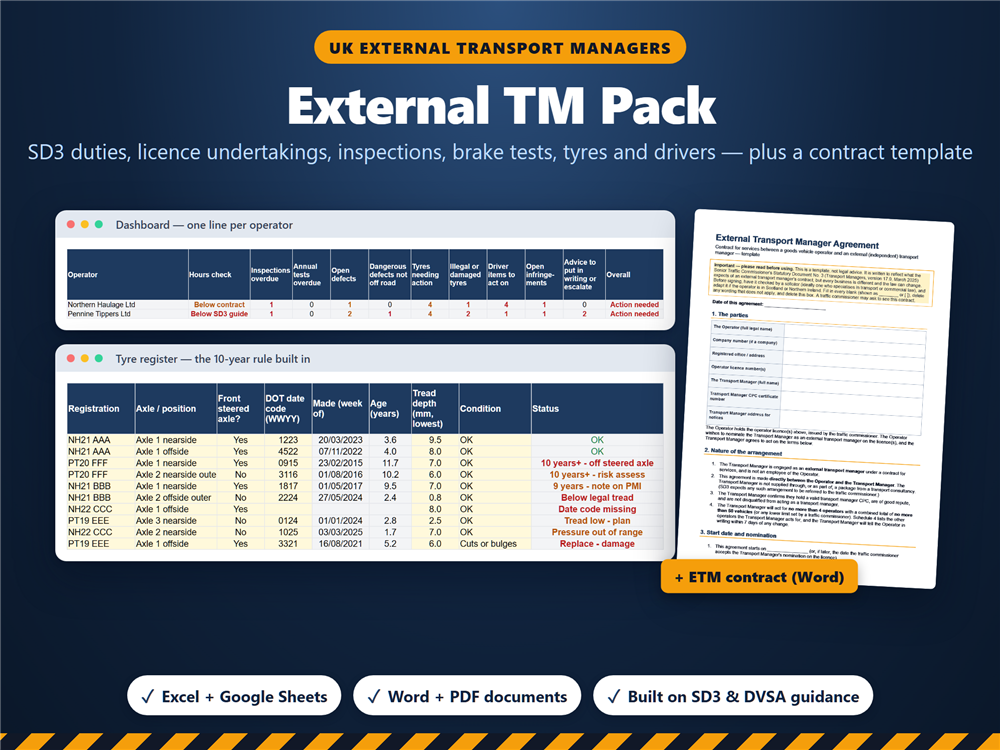
Our External TM Pack has all of this in one Excel and Google Sheets workbook (dashboard, operators and the 4/50 check, TM time, SD3 duties, undertakings, vehicles, inspections and brake tests, defects, tyre register, drivers and infringements, reports and advice), plus an ETM contract template, walkaround check sheet and monthly report in Word and PDF.
See the template on EtsyOfficial sources
- GOV.UK: Senior Traffic Commissioner's Statutory Document No. 3, Transport Managers
- GOV.UK: DVSA Guide to maintaining roadworthiness
- GOV.UK: Goods vehicle operator licensing guide
- GOV.UK: Carry out daily HGV walkaround checks
- GOV.UK: Banning tyres aged 10 years and older (consultation outcome)
- GOV.UK: Drivers' hours