Home › Transport › Driver toolbox talks
Driver toolbox talks: why you need them and how to record them
A toolbox talk is a short briefing, usually 10 to 15 minutes, on one safety or compliance topic. For an operator, a signed record of regular talks is some of the simplest evidence there is that drivers are trained and the transport manager is managing them.
 DRIVER TRAINING
The short version
- The operator licence undertakings include drivers reporting defects promptly and following drivers' hours rules. Drivers need to know how.
- DVSA expects a working walkaround check and defect reporting system, and SD3 lists driver training among a transport manager's tasks.
- The Health and Safety at Work etc. Act 1974 requires employers to give the information, instruction and training needed for health and safety.
- Toolbox talks don't count towards Driver CPC hours, but they keep the key points fresh between courses.
- Get every driver to sign, and keep a register of who has missed which talk.
1. The operator licence undertakings
To get a goods vehicle operator licence, the operator promises the traffic commissioner a set of things for the life of the licence. Several of them depend on drivers doing their part:
- arrangements to make sure drivers' hours and tachograph rules are followed
- drivers report safety defects promptly, and defects are repaired
- vehicles are not overloaded and speed limits are observed
- drivers hold the right licence and training
If these promises aren't kept, the traffic commissioner can call the operator to a public inquiry and revoke, suspend or curtail the licence. Showing that drivers were briefed on each of them, and signed to say so, is part of the operator's answer.
2. What DVSA and traffic commissioners expect
The DVSA Guide to maintaining roadworthiness expects drivers to carry out a walkaround check before the vehicle is used, at least once in every 24 hours it's in service, and to report defects in writing. Drivers need training to do that well. Statutory Document 3 lists driver training, defect reporting, drivers' hours and licence checks among the things a transport manager is expected to manage.
When things go wrong, investigators look for evidence. A run of tachograph infringements, poor defect reports or a bridge strike leads to the question: what training did this driver get, and when? A dated, signed toolbox talk on that exact topic is a strong answer. So is a debrief after an infringement.
3. How toolbox talks fit with Driver CPC
Professional lorry and bus drivers need 35 hours of periodic training every 5 years to keep their Driver CPC. That training has to be on approved courses, so a toolbox talk on its own doesn't add to the 35 hours.
The two work together: Driver CPC courses cover topics in depth every few years, and toolbox talks keep the key points fresh every week, applied to your own vehicles, sites and routes. See our external TM records guide for how training fits into the TM's evidence.
4. Health and Safety at Work Act duties
Section 2 of the Health and Safety at Work etc. Act 1974 requires employers to ensure, so far as is reasonably practicable, the health and safety of employees, including by providing the information, instruction, training and supervision needed. Section 7 requires employees to take reasonable care and co-operate. HSE is clear that work-related driving is part of this: employers must manage the risks to drivers and to others on the road.
Many of the highest risks for drivers happen off the road too: falls from vehicles, coupling and uncoupling, reversing in yards, manual handling and tail-lifts. Toolbox talks are a practical way to cover them.
5. What a good toolbox talk looks like
- ShortOne topic, 10 to 15 minutes, at a regular time
- Why it mattersA real reason, ideally from your own operation
- The rule and its sourceSo drivers know it isn't just company opinion
- QuestionsGet drivers talking about their own jobs
- A signatureEvery driver who attended signs a sheet
- A catch-upFor drivers who were out on the road
6. Topics to cover over a year
| Area | Examples |
|---|---|
| Vehicle | Walkaround checks, defect reporting, tyres and tyre age, wheel security, fuel leaks, electric vehicles |
| Load | Load security, straps and edge protection, weights and overloading, dangerous goods basics |
| Hours and tachographs | Driving limits, breaks and rest, GB domestic rules, driver cards, manual entries, downloads, working time |
| On the road | Mobile phones, speed limits, smart motorways, bridge strikes, vulnerable road users, blind spots, level crossings |
| Yard and sites | Reversing, coupling and uncoupling, loading, falls from vehicles, manual handling, tail-lifts, hi-vis |
| The driver | Fatigue, drink and drugs, eyesight and health, Driver CPC, licence points |
| Weather and incidents | Ice, fog and wind, heat and glare, what to do after a collision, reporting to the company, roadside checks |
Some key figures drivers should know: tyres aged 10 years or more must not be used on the front steered axle of an HGV; a break of at least 45 minutes is due after 4 hours 30 minutes of driving; and the Highway Code asks you to leave at least 1.5 metres when overtaking cyclists at up to 30 mph. For the operator's side of tyres and maintenance, see why an external TM needs a proper ETM pack.
7. Recording sign-offs
- Use one sign-off sheet per talk: date, presenter, the topic, and each driver's name and signature.
- Keep the signed sheets with your training records, by date.
- Keep a register of which drivers have signed which talks, so you can catch up drivers who missed one, and only expect new starters to have had the talks given since they joined.
- Record the talk on the TM's own log too (for example as a driver meeting or briefing).
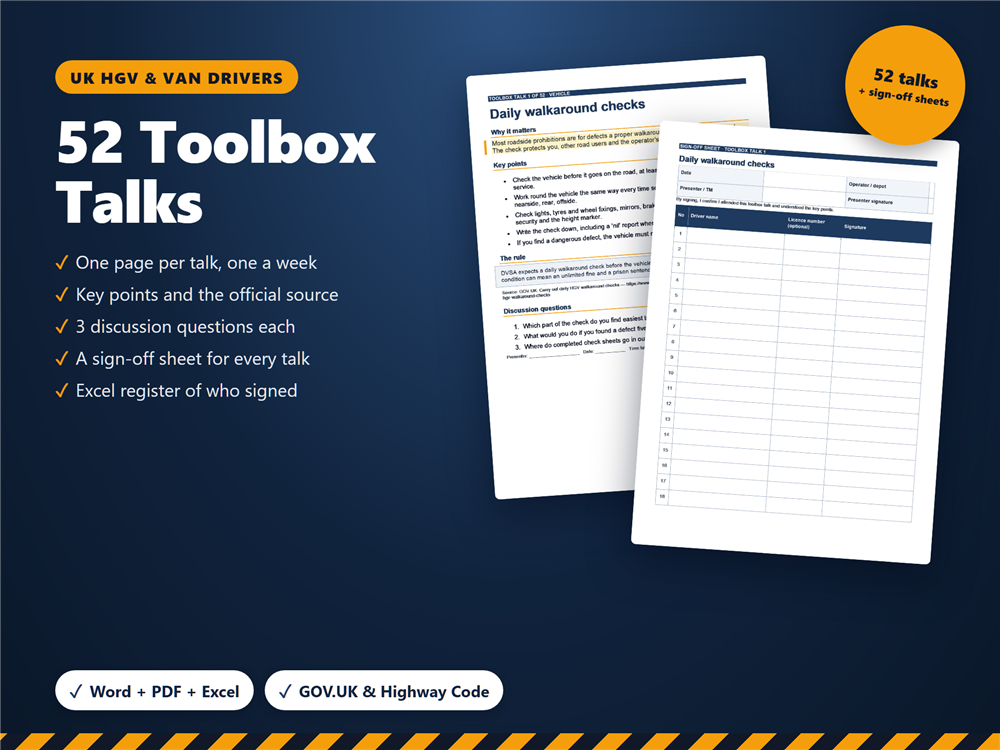
Our 52 Toolbox Talks pack has one talk a week for a year, each on one page with key points, the rule and its official source and three discussion questions, followed by its own sign-off sheet. It comes in Word and PDF with an Excel register that shows who has missed which talk.
See the template on EtsyOfficial sources
- GOV.UK: Goods vehicle operator licensing guide
- GOV.UK: DVSA Guide to maintaining roadworthiness
- GOV.UK: Statutory Document 3, Transport Managers
- GOV.UK: Driver CPC training
- legislation.gov.uk: Health and Safety at Work etc. Act 1974, section 2
- HSE: Driving and riding safely for work
- GOV.UK: The Highway Code